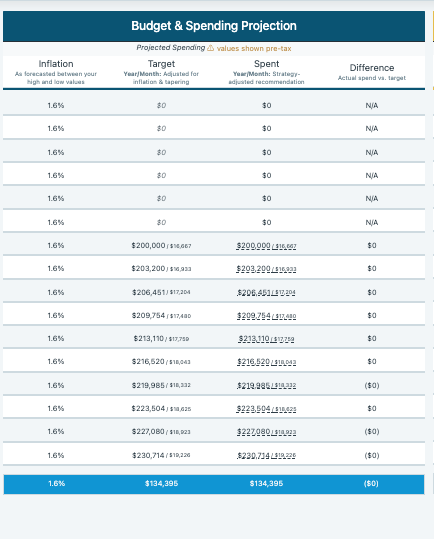
Build a Budget That Reflects Your Retirement
Your retirement budget will look different from your working budget. Some expenses disappear — commuting costs, professional wardrobe, work lunches, retirement contributions. Others increase — healthcare before Medicare at 65, travel if that's your plan, hobbies and activities to fill the time. Some stay roughly the same — housing, utilities, food, insurance.
The best starting point is your current spending. Track what you actually spend for a few months, subtract work-related costs, add retirement-specific expenses, and you'll have a realistic annual spending target. This bottom-up approach is far more accurate than the common rule of thumb that says you'll need 70-80% of your pre-retirement income — some people need more, many need less.
Once you have your annual target, Evernest shows you whether it's sustainable. Enter the number, and the software calculates year-by-year whether your portfolio and income sources can support that spending level through age 90, 95, or beyond. If not, you can test adjustments — $3,000 less per year, starting Social Security later, adding part-time income — and see which changes bring the budget into balance.
Stress-Test Your Budget Over 30 Years
A budget that works at 65 might not work at 85. Inflation erodes purchasing power. Healthcare costs rise with age. Social Security's cost-of-living adjustments may not keep pace with your actual cost increases. And your portfolio — which might seem ample at 65 — has been funding withdrawals for 20 years by the time you're 85.
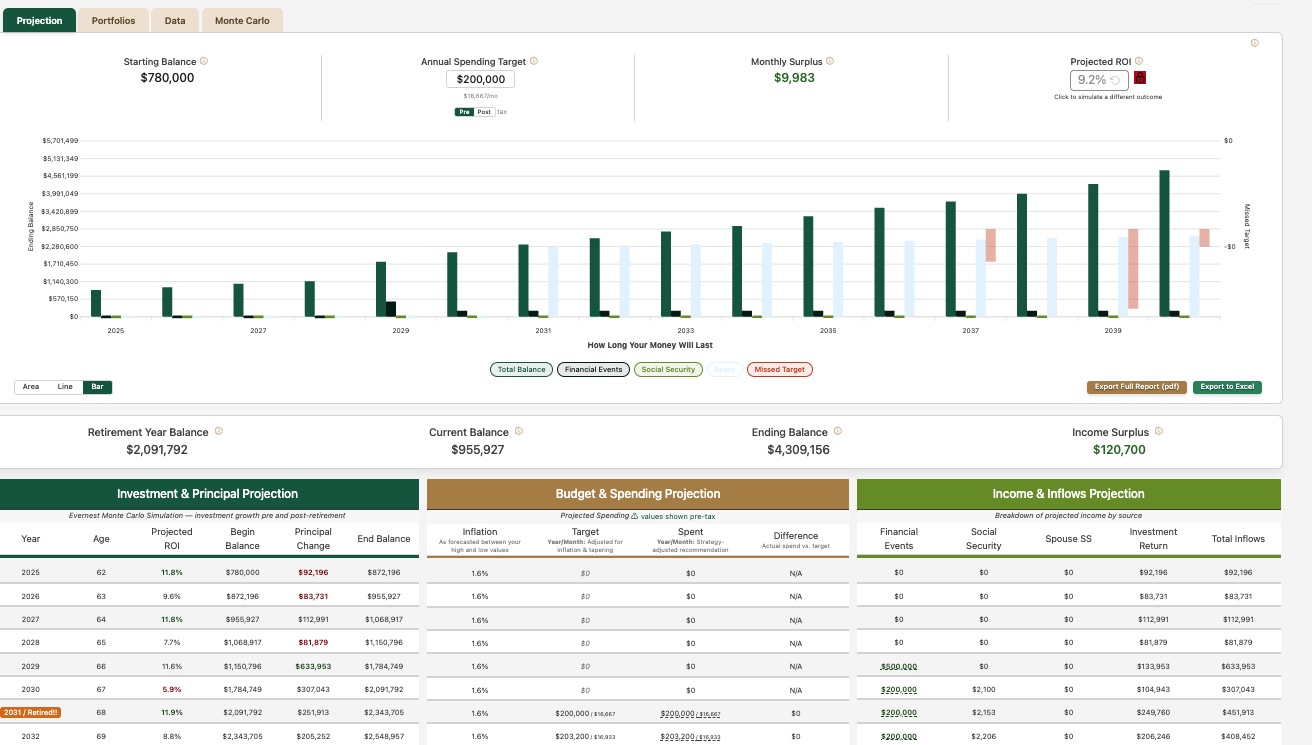
Evernest's year-by-year projection stress-tests your budget against the full length of retirement. You can see exactly which year your budget becomes unsustainable (if it does), and how close to the edge you are in every other year. The income shortfall metric — the gap between your spending and your income — tells you how hard your portfolio is working at each stage.
Taper spending is the most realistic approach for most budgets. Instead of assuming you'll spend $55,000 every year for 30 years, model spending that starts at $55,000 and gradually decreases to $40,000 by age 85. This reflects how most people actually spend in retirement and can extend a portfolio by roughly 8–12 years in our examples.
Adjust and Refine as Life Changes
Your retirement budget isn't static — it evolves as your life does. A great year in the market might give you room for extra travel. A health issue might redirect spending. Downsizing your home changes your fixed costs. Each change affects your budget and your long-term sustainability.
Evernest makes ongoing budget management simple. Update your spending target, adjust income sources, add one-time expenses, and the projection recalculates instantly. You can check in quarterly, annually, or whenever something changes — each time seeing a fresh 30-year outlook that tells you whether you're on track.
Frequently Asked Questions
How do I create a retirement budget?
Start with your current spending as a baseline, then adjust for retirement changes: eliminate work expenses, add healthcare costs, adjust housing if downsizing, and account for lifestyle changes. Evernest uses your total annual spending target to project year-by-year whether your savings and income can sustain that budget.
How much should I budget for retirement per month?
The right monthly budget depends on your lifestyle, location, and debt. Rather than targeting a percentage of pre-retirement income, work from your actual spending. Track what you spend, remove work costs, add retirement expenses, and test that target against your savings and income in Evernest.
Should my retirement budget decrease over time?
Research shows most retirees naturally spend less as they age. Active spending peaks in the 60s-70s and declines. Evernest supports taper spending models that reflect this, which can extend a portfolio by roughly 8–12 years in our examples compared to flat budget assumptions.
Related Resources
Retirement Spending Planner
Find your sustainable spending level with taper strategies.
Retirement Cash Flow Planning
Track money in and out of your retirement accounts year by year.
Retirement Withdrawal Calculator
Test withdrawal rates and see how long your savings will last.
Safe Withdrawal Rate Calculator
Go beyond the 4% rule and find your personalized safe rate.
Build Your Retirement Budget
Set your spending target and see whether it holds up over 30 years. Test adjustments, model taper spending, and find the budget that works for your retirement.
No credit card required · No signup needed for demo