Plan Your Retirement Spending
Spending is where retirement planning gets personal. Your savings and income sources are the supply side of the equation — important, but relatively fixed once you've reached retirement. Spending is the demand side, and it's the variable you have the most control over. A small change in annual spending can shift your money's longevity by a decade.
Most people approaching retirement have a rough sense of what they spend each year, but they haven't connected that number to their long-term financial trajectory. Spending $65,000 per year feels manageable when you have $800,000 saved — but will your money last 25 years at that rate? 30 years? What if Social Security covers part of that spending? What if you taper your spending naturally as you age? The answers depend on dozens of interacting variables, and that's exactly what a retirement spending planner helps you sort out.
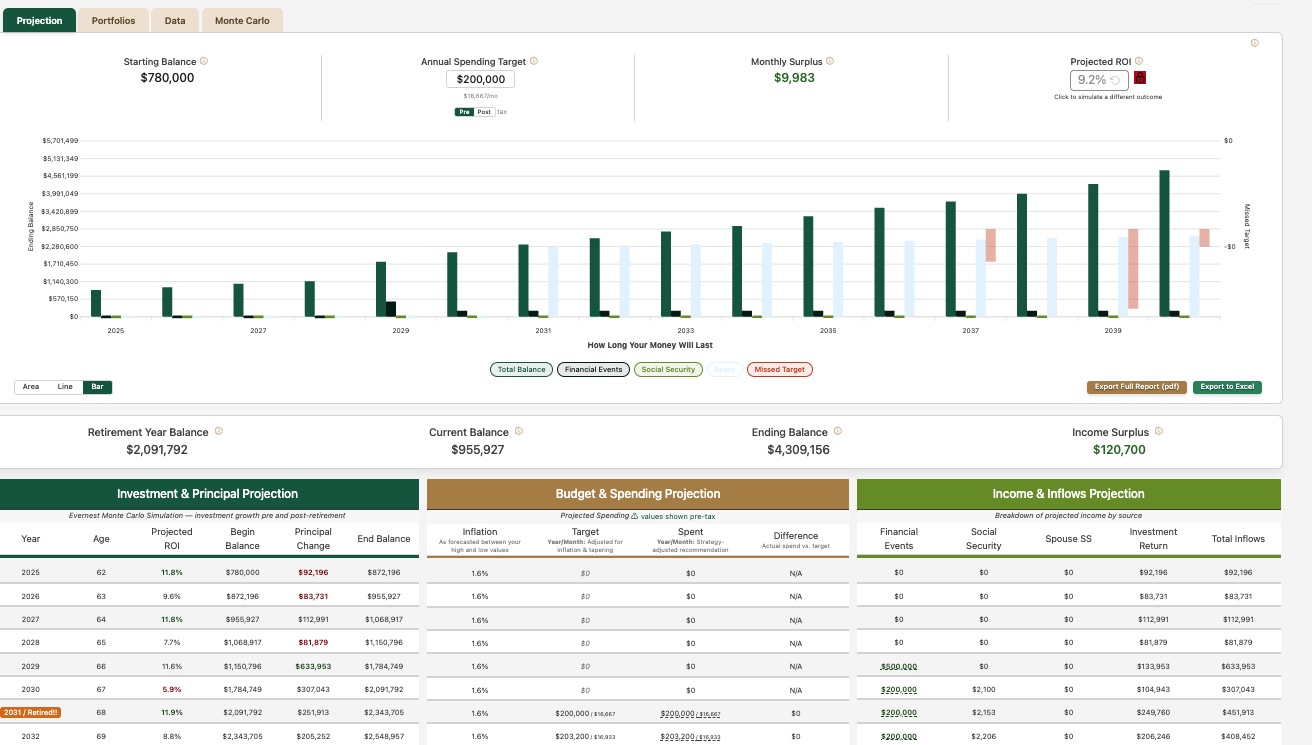
Evernest shows you the full picture. Enter your spending target and the software calculates your income shortfall (the gap between spending and income), your portfolio withdrawal rate, and your projected balance for every year of retirement. You can immediately see whether your current spending level is sustainable — or whether a modest adjustment could add years to your money's lifespan.
See How Spending Affects Your Future
The relationship between annual spending and long-term financial security isn't linear — it's exponential. A $5,000 annual reduction in spending saves you $5,000 per year in direct costs, but it also means $5,000 per year stays invested and continues earning returns. Over 25 years, that $5,000 annual savings compounds to an additional $250K–$350K in your portfolio if that money stays invested at 5–8% ($125K in spending, not counting growth).
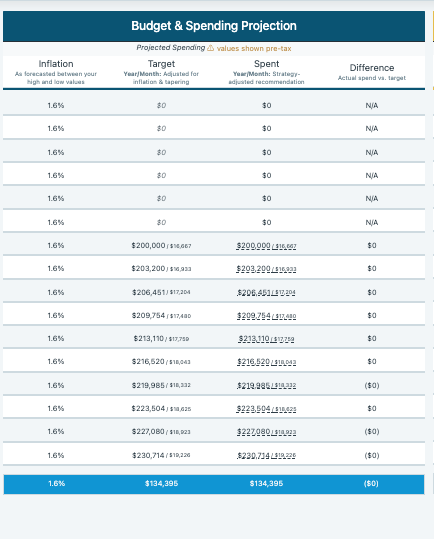
This compounding effect means that even modest spending adjustments can dramatically extend your retirement timeline. Evernest makes this visible by updating your entire 30-year projection every time you change your spending target. You can watch in real time as a $3,000 annual cut pushes your money's exhaustion date from 82 to 87, or as adding $5,000 per year pulls it from 90 to 84.
This isn't about deprivation — it's about understanding the tradeoffs. Maybe that extra $5,000 per year in travel is absolutely worth arriving at a thinner financial cushion at 85. Or maybe you'd rather have the security and find that you don't miss the spending. The point is to make the choice with full information instead of guessing.
Balance Lifestyle and Financial Security
The biggest tension in retirement spending is the fear of two opposite mistakes: spending too much and running out of money, or spending too little and missing out on the retirement you worked decades to earn. Both are real risks, and the optimal path lies somewhere in between.
Taper spending is one of the most effective strategies for balancing lifestyle and security. Research consistently shows that retirees naturally spend less as they age. Active spending on travel, dining, hobbies, and entertainment peaks in the early retirement years (65-75) and gradually declines. By the 80s, most retirees are spending 20-30% less than they did in their 60s, even accounting for rising healthcare costs.
Evernest lets you model taper spending that reflects this reality. Instead of assuming flat spending of $60,000 per year for 30 years, you can model $60,000 at 65 that gradually tapers to $45,000 by 85. The impact on your projections is dramatic: flat spending at $60,000 might deplete your portfolio at 83, while tapered spending starting at the same amount might sustain you through 94. That's an eleven-year difference from a spending model that more accurately reflects how people actually live.
You can also layer in one-time expenses for big-ticket items. A kitchen renovation at 68, a new car at 72, helping a grandchild with college at 75 — these events affect your balance in the year they happen and alter your trajectory for every year after. Evernest absorbs these events into your timeline so you can see their long-term ripple effects alongside your ongoing spending plan.
Build a Personalized Spending Plan
Your retirement spending plan should be as unique as your retirement. A couple planning to travel extensively in their 60s needs a different spending profile than someone planning a quiet retirement at home. A person with a paid-off house has different fixed costs than someone renting. A retiree with a pension covering basic expenses can afford to be more flexible with discretionary spending than someone relying entirely on their portfolio.
Evernest adapts to all of these situations because it models your complete financial picture. Your spending target is just one input — it sits alongside your portfolio balance, investment returns, Social Security, pension income, part-time work, and any other income sources. The projection shows you how all of these elements interact to determine whether your spending level is sustainable.
The budget and spending projection table breaks your annual spending into context. You can see exactly how much of your spending is covered by income versus portfolio withdrawals, and how that ratio shifts over time as Social Security starts, as pensions kick in, or as part-time work ends. This level of detail transforms spending planning from an abstract exercise into a concrete, year-by-year roadmap you can actually follow.
Get Started Free
Building your retirement spending plan takes minutes, not hours. Enter your current savings, set your spending target, configure your income sources, and Evernest generates a complete year-by-year projection. From there, start testing — lower spending by $5,000, raise it by $3,000, add taper spending, model a one-time purchase — and watch how each change ripples through your entire retirement timeline.
No credit card required, no advisor appointment needed. Just you, your numbers, and a clear view of how your spending choices shape the next 30 years of your life.
Frequently Asked Questions
How much can I safely spend in retirement?
There's no universal answer — it depends on your savings, income sources, retirement age, and how long you need your money to last. The traditional 4% rule suggests spending 4% of your portfolio in year one, but most people benefit from a more personalized approach. Evernest calculates your sustainable spending level based on your actual numbers and shows you the long-term effect of any spending amount you choose.
What is taper spending in retirement?
Taper spending is a strategy where your annual spending gradually decreases as you age, reflecting the well-documented pattern that most retirees naturally spend less in their 80s than in their 60s. Travel, dining, and activity spending typically declines, while healthcare costs may rise but often not enough to offset the decrease. Evernest supports taper spending, which can extend a portfolio by roughly 8–12 years in our examples compared to flat spending assumptions.
Should I budget for healthcare separately in retirement?
Healthcare is best modeled as part of your total annual spending in Evernest. If you expect a specific large medical expense in a particular year, you can add it as a one-time event. For ongoing costs, include them in your annual spending target. Many retirees find that healthcare cost increases in their 80s are partially offset by decreases in travel and activity spending — taper spending models this naturally.
Related Resources
Retirement Withdrawal Calculator
Test different withdrawal rates and see how long your savings will last.
Retirement Cash Flow Calculator
Forecast income, expenses, and portfolio balance year by year.
How Long Will My Money Last?
See exactly which year your money might run out and how to extend it.
Retirement Scenario Planning Tool
Compare different retirement scenarios and find the best path forward.
Find Your Sustainable Spending Level
See how your spending decisions shape the next 30 years. Test different amounts, model taper strategies, and find the balance between lifestyle and lasting security.
No credit card required · No signup needed for demo