More Than Just the Monthly Check
Most Social Security advice focuses on maximizing the monthly benefit amount: "delay to 70 for the biggest check." That's not wrong, but it's incomplete. The optimal claiming strategy depends not just on the benefit amount, but on how that benefit interacts with your portfolio withdrawals, your spending needs, your tax situation, and how long you need your money to last.
Delaying to 70 gives you a 77% larger benefit than claiming at 62 — roughly $1,540 more per month on a $2,000 base benefit. That's $18,480 more per year, for life. But to get that benefit, you forgo eight years of income and must fund the gap from your portfolio. Whether this tradeoff makes sense depends entirely on your portfolio's ability to sustain those gap-year withdrawals.
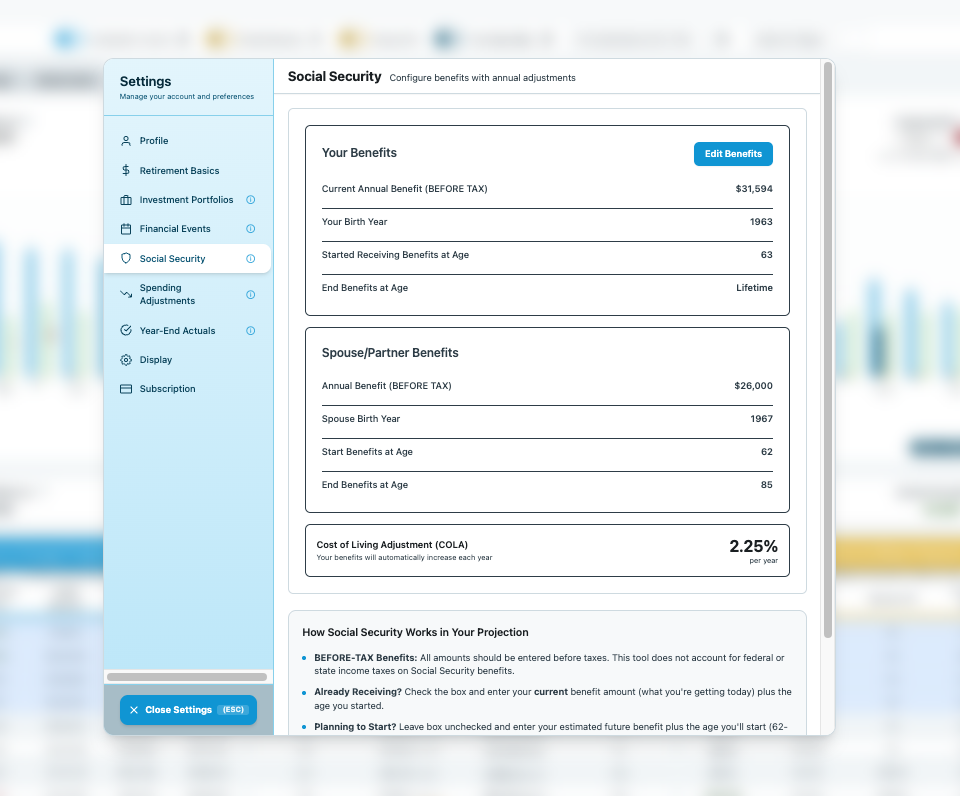
True optimization means finding the claiming age where the larger benefit produces the best outcome for your total retirement plan — not just the largest monthly check, but the strategy that keeps your money lasting the longest while funding the lifestyle you want. Evernest shows you this by modeling Social Security as one piece of your complete financial picture.
Spousal and Survivor Strategies
For married couples, Social Security optimization gets significantly more interesting. Two benefits create a matrix of claiming combinations — the higher earner might claim at 62, 67, or 70, and the lower earner independently at 62, 67, or 70. That's nine possible combinations, each producing a different lifetime income stream.
The most common optimal strategy for couples is to have the higher earner delay to 70 while the lower earner claims at or near 62. The lower earner's early benefit provides household income during the gap years, reducing portfolio withdrawals. The higher earner's delayed benefit maximizes the survivor benefit — the larger of the two benefits continues to the surviving spouse for the rest of their life.
This survivor benefit is often overlooked but critically important. When one spouse passes, the household loses the smaller Social Security check but keeps the larger one. If the higher earner maximized their benefit by delaying to 70, the surviving spouse inherits a significantly larger income floor for what could be decades of solo retirement. Evernest models both benefits and shows the household impact over time.
Find Your Optimal Strategy
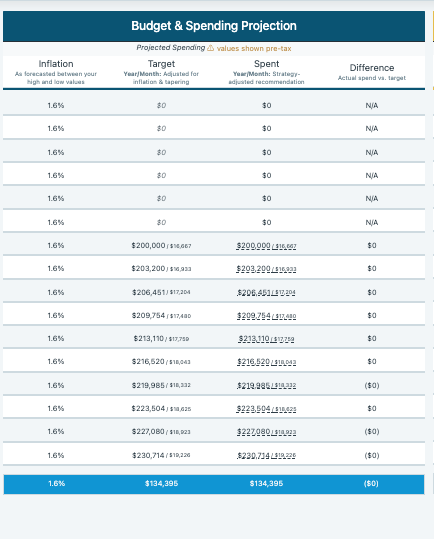
Evernest makes Social Security optimization practical by showing you the full-plan impact of each claiming age. Change your Social Security start date and the entire 30-year projection updates instantly — portfolio withdrawals adjust, income shortfalls recalculate, and you can see exactly how the claiming age affects your money's longevity.
Start by testing the three standard ages: 62 (earliest), 67 (full retirement age for most), and 70 (maximum benefit). Look at your portfolio balance at age 85 under each scenario. Often, one option is clearly stronger — and it may not be the one you expected. People with smaller portfolios sometimes find that claiming early preserves their savings better because the gap-year withdrawals at 70 are too aggressive. People with larger portfolios often find that delaying is an obvious winner.
The answer is in your numbers, not in generic advice. Ten minutes of testing with Evernest will tell you more about your optimal strategy than hours of reading articles about Social Security timing.
Frequently Asked Questions
How do I optimize my Social Security benefits?
Find the claiming age that maximizes the total value of your benefits within the context of your complete retirement plan. This means considering not just the monthly amount but how it interacts with your portfolio, spending, and other income. Evernest shows the full-plan impact.
What is the break-even age for delaying?
The break-even age is typically about 78–79 for 62 vs 67, 80–81 for 62 vs 70, and 82–83 for 67 vs 70 — when total delayed benefits overtake total early benefits. But the real question is how each option affects your complete retirement plan, including portfolio sustainability, not just total Social Security dollars.
Should the higher earner always delay to 70?
In most cases, yes — especially for married couples, since it also maximizes the survivor benefit. However, health concerns or immediate income needs may make earlier claiming appropriate. Model both options with your actual numbers to decide.
Related Resources
Social Security Planning Calculator
Compare claiming ages with detailed year-by-year projections.
When Should I Take Social Security?
Deep dive into timing strategies and their long-term effects.
Retirement Income Calculator
See how Social Security fits into your total income picture.
Retirement Income Planning Software
Build a complete income plan combining all your retirement sources.
Maximize Your Social Security
Find the claiming strategy that gives you the most income for life. Compare ages 62, 67, and 70 — and see the full impact on your retirement plan.
No credit card required · No signup needed for demo