The Real Question: Will My Retirement Plan Work?
Most retirement planning tools ask you to fill in a few numbers and then hand you a single verdict: you're on track, or you're not. That might be reassuring for five minutes, but it doesn't help you make actual decisions. When should you claim Social Security? Can you afford to retire at 62 instead of 65? What happens if you sell your house at 72 and downsize? What if the market drops 30% in your first year of retirement?
These are the questions that keep people up at night — and they're exactly the questions that a simple calculator can't answer. Real retirement planning requires software that models the complexity of real life: multiple income streams starting and stopping at different ages, spending that changes over time, one-time financial events like home sales or inheritances, and the compounding effects of all these variables interacting over a 30-year timeline.
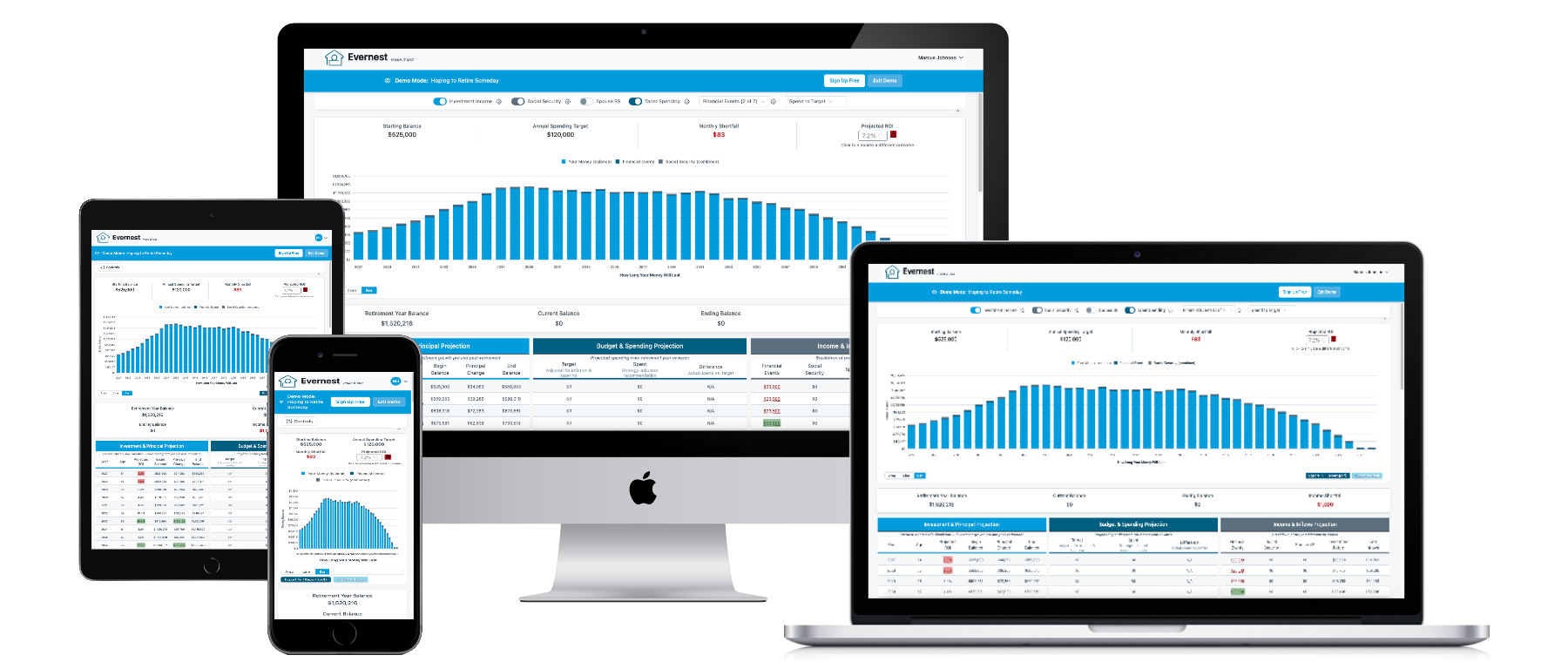
Evernest is retirement planning software built for this kind of thinking. Instead of reducing your financial future to a single number, it unfolds your retirement year by year — showing you your projected balance, income sources, spending, and shortfalls at every age from now through 100 and beyond. You see the full story, not the summary.
That matters because retirement isn't a single moment. It's a decades-long phase of life with distinct chapters: the early active years when spending is highest, the middle years when it typically tapers, and the later years when healthcare costs may rise while other expenses fall. Software that shows you all of these chapters — and lets you model different approaches for each — gives you something a calculator never can: confidence that you've actually thought it through.
More Than a Retirement Calculator
The difference between a retirement calculator and retirement planning software is the difference between a snapshot and a movie. A calculator takes your current savings, expected return, and target retirement age, runs a formula, and tells you a number. It might even be a useful number. But it can't show you what happens in year 12 when your spouse starts Social Security, or in year 18 when you sell the lake house, or in year 23 when your spending drops because you've stopped traveling.
Evernest builds a complete projection of your financial life. Every year gets its own row in the timeline, with your beginning balance, investment returns, income sources, spending, and ending balance calculated individually. When you add a financial event — a home sale at age 73, a part-time consulting income from 62 to 67, an inheritance at 70 — it shows up exactly where it belongs in your timeline, and every year after it reflects the change.
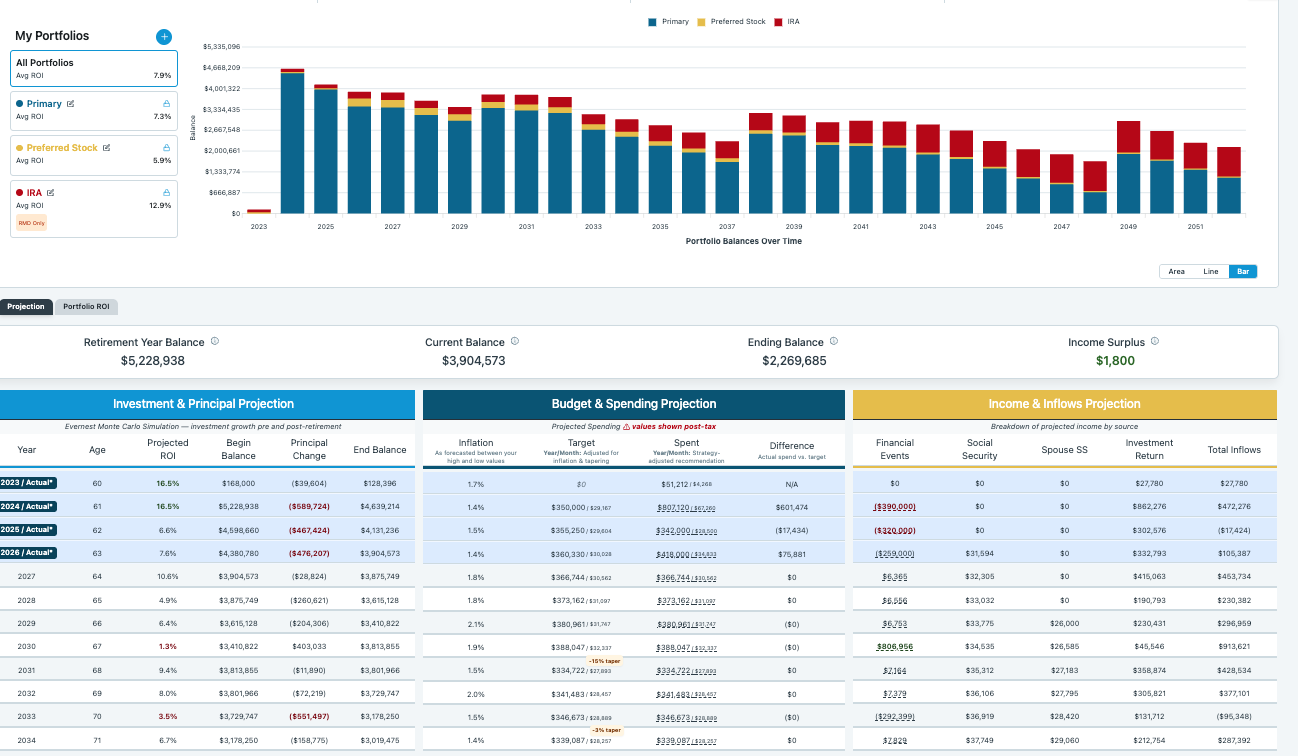
This is what makes real planning possible. You're not guessing whether your money will last — you're watching it flow through time, seeing exactly where the pressure points are, and testing different approaches to address them. Move Social Security from 62 to 67 and watch the entire projection recalculate instantly. Add a taper spending strategy that reduces your spending by 2% per year after age 75 and see how it can extend a portfolio by roughly 8–12 years in our examples.
The visual component matters more than most people expect. Seeing a chart of your projected balance over 30 years communicates something that a table of numbers cannot. You immediately notice the year where income starts exceeding expenses, the inflection point where Social Security kicks in, or the alarming year where your balance crosses zero. These visual patterns make abstract financial concepts concrete and actionable.
Evernest gives you three ways to view your projection: as an area chart that shows the flow of your wealth over time, as a bar chart that makes year-over-year comparisons clear, or as a line chart for tracking trends. Each view serves a different kind of analysis, and switching between them is instant — because the way you need to look at your data changes depending on the question you're trying to answer.
Model Your Retirement Future
The power of retirement planning software comes from modeling — testing different versions of your future to find the approach that works best for your specific situation. Evernest gives you the controls to model the decisions that actually move the needle.
Social Security Timing
When to claim Social Security is one of the most consequential financial decisions you'll make in retirement. Claiming at 62 means smaller monthly checks but more years of income. Waiting until 70 means larger checks but drawing down your portfolio longer before they start. The right answer depends on your savings, health, other income sources, and spending needs — and it's different for everyone.
Evernest lets you set your Social Security start age and your spouse's independently, then shows you the combined effect on your entire projection. You can test every combination — both claiming early, both claiming late, one early and one late — and see immediately which approach gives your money the longest life. The software calculates your estimated benefit at each age based on your input, so you see realistic numbers, not approximations.
Spending Strategies
Not everyone spends the same amount every year of retirement. Research consistently shows that retirees tend to spend more in the early "go-go" years, less in the middle "slow-go" years, and more again in the late "no-go" years when healthcare costs rise. A flat spending assumption ignores this reality and can make your projections either too optimistic or too pessimistic.
Evernest supports taper spending strategies that let you model declining spending over time. Set your initial annual spending target, then configure how and when it decreases. The projection adjusts every year's spending individually, giving you a much more realistic picture of how your money will actually flow. The difference between a flat spending assumption and a tapered one can be the difference between "running out at 82" and "comfortable through 95."
Financial Events
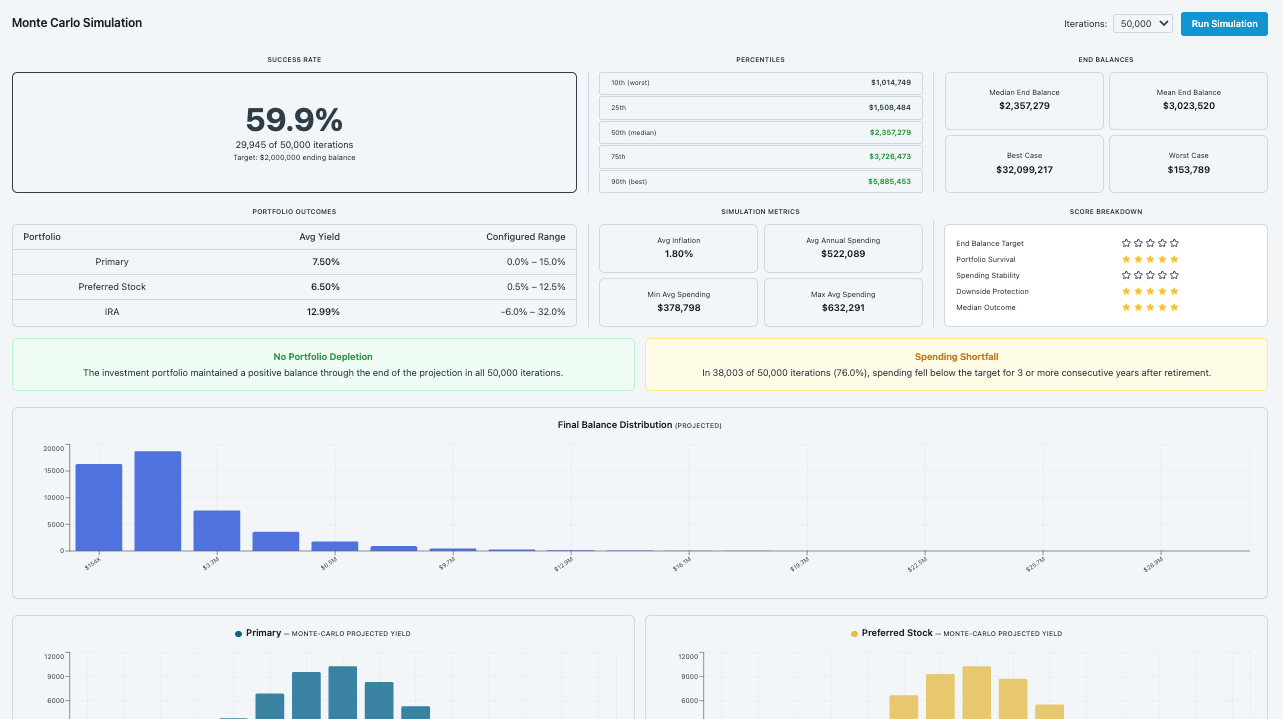
Life doesn't happen in a straight line, and neither should your retirement plan. Evernest lets you schedule one-time financial events at any point in your timeline: a home sale at 73, an inheritance at 68, a new car purchase at 70, consulting income from 62 to 66, or a lump-sum pension payout at retirement. Each event lands in the exact year you specify and ripples through every subsequent year's projection.
This is where retirement planning software truly separates from calculators. A calculator can't show you how selling your house could extend your money, because it can't model the timing. Evernest can: the sale proceeds replenish your investments, and selling earlier could mean fewer years of property taxes and maintenance while the invested proceeds have longer to grow. These second-order effects are invisible in a simple calculation but obvious in a year-by-year projection.
Plan Before and After Retirement
One of the most common misconceptions about retirement planning software is that it's only useful once you're already retired. In reality, the years leading up to retirement — roughly age 50 to 65 — are when this kind of modeling is most valuable, because the decisions you make during this window have the largest impact on your financial future.
If you're five to fifteen years from retirement, Evernest helps you answer the question that matters most: when can I afford to stop working? By modeling different retirement ages — 60, 62, 65, 67 — you can see exactly how each additional year of work affects your long-term projection. Sometimes the difference between retiring at 62 and 64 is the difference between running out of money at 85 and being comfortable through 95. Other times, you discover you could have retired two years ago.
For people already in retirement, the software serves a different but equally important purpose: ongoing validation and adjustment. Your original plan was based on assumptions about market returns, spending levels, and life events. As reality unfolds — markets outperform or underperform, spending patterns shift, unexpected expenses arise — you need a way to see how these changes affect your long-term outlook.
Evernest tracks your current balance against your projection, showing you whether you're ahead or behind your plan at any point. If you're behind, you can immediately test adjustments: reducing spending by $5,000 per year, delaying a major purchase, or picking up part-time work for a few years. If you're ahead, you can see how much additional spending you can safely add without jeopardizing your long-term security.
This ongoing feedback loop is what turns a one-time planning exercise into a living plan that evolves with you. Retirement isn't something you plan once and forget. It's a 30-year journey that benefits from regular check-ins and course corrections — and having the right software makes those check-ins take minutes instead of hours.
Why Choose Evernest
There are plenty of retirement tools on the internet, and most of them do the same thing: ask for your savings, age, and expected return, then spit out a number. Evernest is built on the belief that this approach fundamentally misunderstands what people actually need from retirement planning software.
What people need is to see their future — not as a single number, but as a timeline. They need to test decisions before making them. They need to understand how different variables interact over decades. And they need to do all of this without hiring a financial advisor or learning spreadsheet formulas.
What sets Evernest apart:
- Year-by-year projections — not a single number, but your complete financial timeline from now through age 100+
- Instant scenario testing — change any variable and the entire projection recalculates immediately, no waiting
- Social Security optimization — model individual and spousal claiming strategies at any age from 62 to 70
- Financial event scheduling — model home sales, inheritances, part-time work, pensions, and any other one-time or recurring event
- Taper spending strategies — model realistic spending that decreases with age rather than assuming flat withdrawals forever
- Visual clarity — area, bar, and line charts that make 30 years of financial data immediately understandable
- Export everything — download your full projection as an Excel spreadsheet or PDF report for offline analysis or advisor review
Evernest is designed to be the tool you come back to — not because it locks you in, but because it genuinely helps you think through your retirement more clearly every time you use it. Whether you're five years from retirement or five years into it, the software adapts to where you are and shows you what comes next.
Financial advisors charge thousands of dollars annually for the kind of projection modeling that Evernest puts in your hands for a fraction of the cost. That's not to say advisors aren't valuable — many users bring their Evernest projections to advisor meetings, making those conversations more productive because both sides are looking at the same data. But for the millions of people who prefer to manage their own finances, or who simply can't justify advisor fees, Evernest provides professional-grade planning tools at a price that makes sense.
Your retirement is too important to plan with a calculator. It deserves software that treats it with the complexity and nuance it actually requires. That's what Evernest is built to do.
Frequently Asked Questions
What makes retirement planning software different from a retirement calculator?
A retirement calculator gives you a single number — usually whether you have "enough." Retirement planning software like Evernest models your complete financial future year by year, showing how Social Security timing, spending changes, home sales, and market conditions interact over a 30+ year timeline. You see the full picture, not just a pass/fail score.
Can I use Evernest before I retire?
Yes. Evernest is designed for both pre-retirees planning ahead and people already in retirement. Pre-retirees can model different retirement ages, test Social Security claiming strategies, and see exactly when they can afford to stop working. The software projects your finances from today through your full retirement timeline.
How much does Evernest retirement planning software cost?
Evernest offers a free plan that includes core projection features. Premium plans with advanced features like extended projections and additional scenario tools are available at $3.99/month billed annually ($7.99 month-to-month).
Is retirement planning software a replacement for a financial advisor?
Evernest is a planning tool, not financial advice. It gives you professional-grade projection capabilities to model your own scenarios and make informed decisions. Many users find it helps them have more productive conversations with their advisors, while DIY planners use it as their primary planning tool.
Related Resources
When Should I Take Social Security?
Compare claiming at 62 vs. 70 and see how timing affects your overall retirement plan.
Do I Have Enough to Retire?
Year-by-year projections showing whether your savings will last through retirement.
How Long Will My Money Last?
See exactly which year your money might run out and test strategies to extend it.
Retirement Calculator Guide
Understanding what makes Evernest different from a standard retirement calculator.
Start Planning Your Retirement
See your complete financial future in minutes. Model Social Security timing, test spending strategies, and find out exactly when you can retire.
No credit card required · No signup needed for demo