Understand Your Retirement Withdrawal Strategy
Your withdrawal strategy is the plan for how you'll convert your retirement savings into income. It sounds simple — take money out each year — but the details matter enormously. Withdraw too much early on and you risk running out in your 80s. Withdraw too little and you spend decades living below your means unnecessarily.
The famous "4% rule" suggests withdrawing 4% of your portfolio in year one of retirement, then adjusting that dollar amount for inflation each subsequent year. It's a reasonable starting point, but it's also a product of historical averages — and your retirement won't be average. Your specific combination of portfolio size, Social Security benefits, pension income, spending needs, and retirement age creates a unique situation that deserves a more nuanced approach than a single rule of thumb.
A retirement withdrawal calculator helps you move beyond rules of thumb by showing you what actually happens to your money under different withdrawal strategies. Instead of trusting that 4% will work, you can see it — year by year, dollar by dollar — and adjust until you find the rate that balances your lifestyle with your longevity.
Estimate How Long Your Savings May Last
The core question behind every withdrawal strategy is simple: will my money outlast me? The answer depends on how much you withdraw, what your investments return, what other income you receive, and how long you need the money to last. Change any one of those variables and the answer can shift by a decade or more.
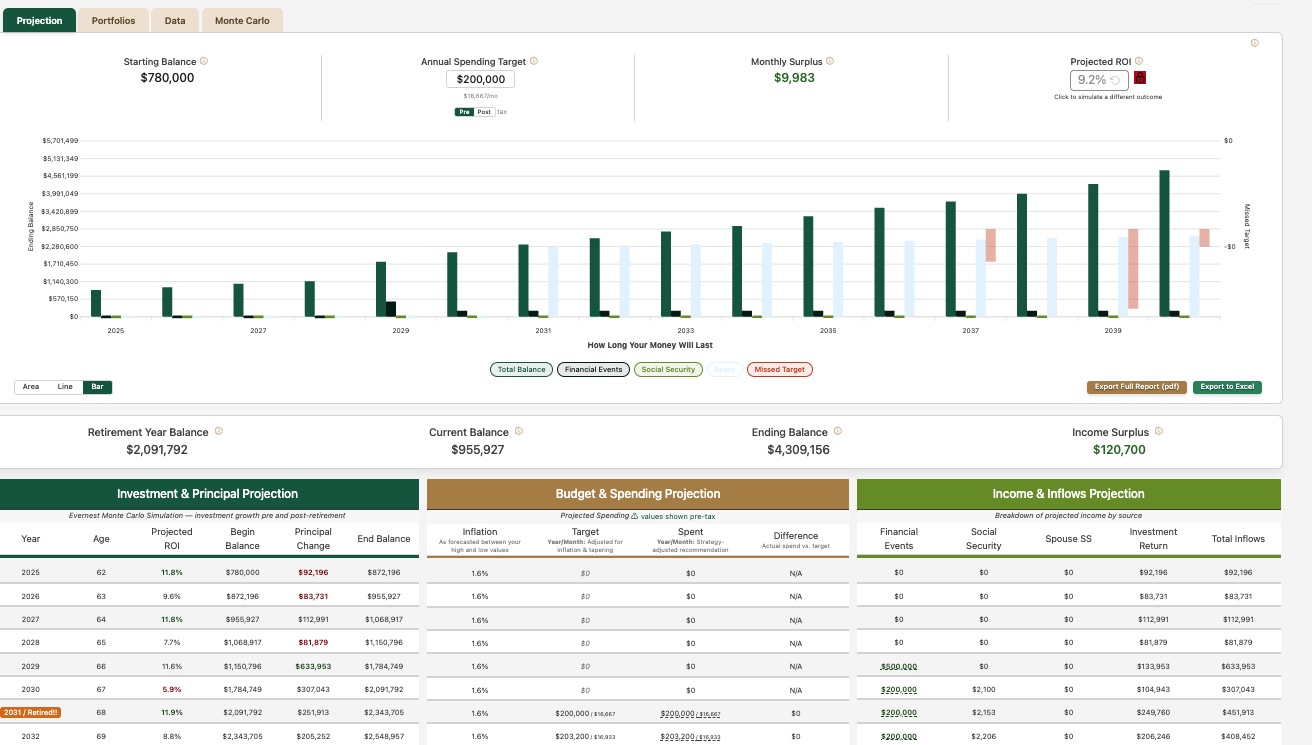
Evernest calculates your projected balance for every year of your retirement. You enter your starting balance, set your annual spending target, configure your Social Security and any other income sources, and the software builds a complete year-by-year timeline. You can immediately see whether your balance stays positive through age 90, 95, or 100 — or whether it hits zero at 78.
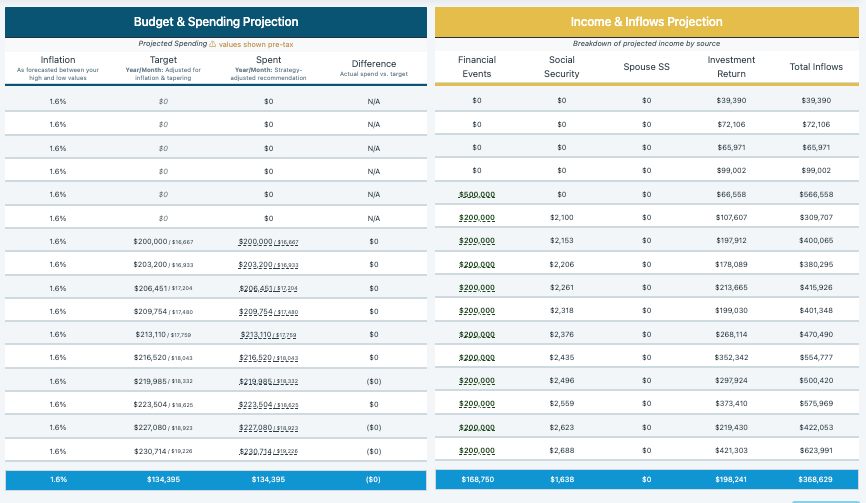
The income shortfall metric is particularly useful. Evernest calculates the gap between your annual spending and your annual income (Social Security, pensions, part-time work) — the amount that must come from your portfolio each year. When your income covers most of your spending, your portfolio barely shrinks. When it doesn't, you can see exactly how fast you're drawing down and which years create the most pressure.
This kind of visibility changes how you think about withdrawals. Instead of picking a rate and hoping it works, you're watching the money flow and understanding the mechanics. That understanding is what turns anxiety into a plan.
Test Different Withdrawal Scenarios
The real power of a withdrawal calculator isn't calculating a single scenario — it's comparing multiple scenarios to find the one that works best for you. Evernest makes this effortless because every change recalculates the entire projection instantly.
Start with your baseline: current savings, expected spending, and planned retirement age. Then start testing. What if you reduce spending by $5,000 per year? The projection updates immediately. For example, with $1,000,000 at 65, $60,000 a year in spending that rises 3% a year with inflation, and a 5% average return, the money lasts about 20 years, to around 85. Cutting spending to $55,000 stretches that to about 22 years, to around 87. What if you delay Social Security from 62 to 67? You'll need higher withdrawals in those five years, but the permanently larger Social Security check reduces your withdrawal needs for every year after. Evernest shows you both sides of that tradeoff.
Taper spending is one of the most powerful — and overlooked — withdrawal strategies. Research consistently shows that retirees naturally spend less as they age. If you're planning to spend $60,000 per year at 65, you probably won't still be spending $60,000 at 85. Evernest lets you configure spending that gradually decreases over time, reflecting how people actually live in retirement. The impact on your projections can be dramatic: a flat $60,000 withdrawal might deplete your savings at 83, while a tapered approach starting at the same amount might last through 94.
You can also model one-time events that affect your withdrawal needs. A home sale at 73 adds a lump sum that reduces withdrawals for years. Part-time consulting from 62 to 66 bridges the gap before Social Security starts. An unexpected medical expense at 80 creates a one-year spike in withdrawals. Each event slots into your timeline and its effects ripple through every subsequent year.
Plan With Confidence Using Evernest
A withdrawal strategy isn't something you set once and forget. Markets fluctuate, spending patterns shift, and life delivers surprises. The value of retirement planning software is that it grows with you — you can update your inputs as reality unfolds and see immediately whether you're still on track.
Evernest tracks your current balance against your projected balance, so you always know where you stand. If the market had a great year and you're ahead of projections, you can see exactly how much extra spending room that creates. If you're behind, you can test small adjustments — reducing withdrawals by $200 per month, delaying a planned purchase by a year — and see which changes get you back on track with the least impact on your lifestyle.
The projection table breaks your finances into three clear views: your Investment & Principal Projection showing portfolio growth and withdrawals, your Budget & Spending Projection showing how your spending is allocated and adjusted over time, and your Income & Inflows Projection showing Social Security, pensions, and other income sources. Together, these three tables give you complete visibility into how money moves through your retirement.
Whether you're trying to determine if 4% is safe for your situation, evaluating whether to spend more in your early retirement years, or stress-testing your plan against poor market performance, Evernest gives you the tools to answer these questions with data instead of guesses. Your retirement is too important for guesswork.
Frequently Asked Questions
What is a safe withdrawal rate for retirement?
The traditional "4% rule" suggests withdrawing 4% of your portfolio in year one, then adjusting for inflation. However, the right withdrawal rate depends on your specific situation — portfolio size, other income sources, retirement age, and spending needs. Evernest lets you model any withdrawal rate and see exactly how it affects your money over 30+ years.
How do I know if my withdrawal rate is too high?
Your withdrawal rate is too high if your projections show your portfolio reaching zero before your planning horizon (typically age 90-100). Evernest's year-by-year projection makes this immediately visible — you can see the exact year your money runs out and test adjustments to extend it.
Should I withdraw the same amount every year in retirement?
Research shows most retirees naturally spend less as they age. Flat withdrawal assumptions often overestimate long-term spending needs. Evernest supports taper spending strategies that model declining withdrawals over time, giving you a more realistic projection of how long your money will actually last.
How does Social Security affect my withdrawal strategy?
Social Security reduces how much you need to withdraw from your portfolio. Delaying Social Security from 62 to 70 increases your monthly benefit by roughly 77%, but requires higher portfolio withdrawals in the interim. Evernest models both sides of this tradeoff, showing you the net effect on your long-term balance.
Related Resources
Retirement Planning Software
Comprehensive retirement modeling with year-by-year cash flow projections.
How Long Will My Money Last?
See exactly which year your money might run out and test strategies to extend it.
When Should I Take Social Security?
Compare claiming at 62 vs. 70 and see how timing affects your withdrawal needs.
Do I Have Enough to Retire?
Year-by-year projections showing whether your savings will last through retirement.
Test Your Withdrawal Strategy
See year by year whether your money will last. Model different withdrawal rates, spending strategies, and Social Security timing — all in minutes.
No credit card required · No signup needed for demo