The Question That Matters Most
Every retirement question ultimately reduces to one: will my money last? It doesn't matter how sophisticated your investment strategy is or how optimized your Social Security timing is if your savings run out at 79. Longevity is the bottom line.
The challenge is that longevity depends on the interaction of many variables: how much you've saved, how much you spend, what your investments return, when you claim Social Security, whether you have a pension, and how long you live. Change any one variable and your money's lifespan can shift by a decade.
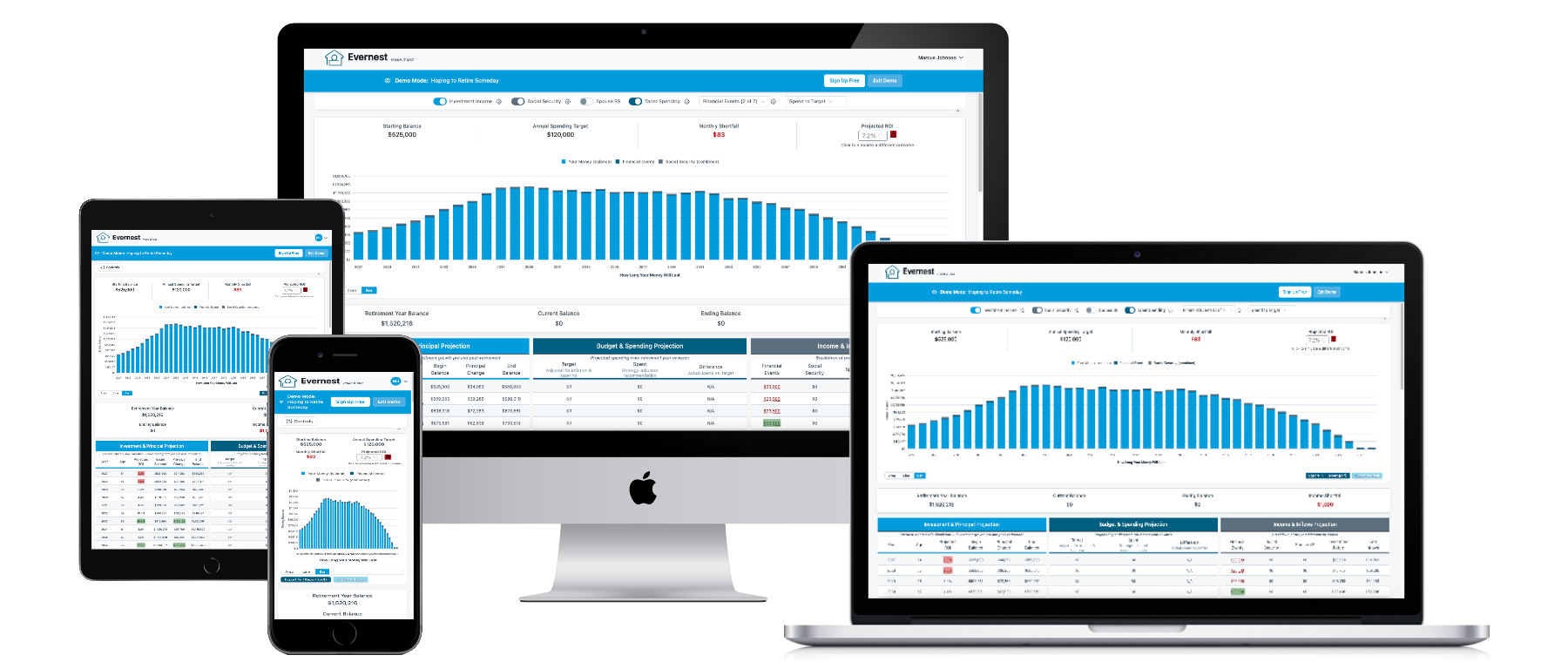
Evernest answers this question definitively by projecting your finances year by year from today through age 95 or beyond. You can see the exact year your portfolio balance reaches zero — or confirm that it stays positive throughout your entire planning horizon. And when you don't like the answer, you can test changes that extend your money's lifespan until you find a plan that works.
What Determines How Long Your Savings Last
Four factors drive savings longevity more than anything else: annual spending, other income (especially Social Security), investment returns, and the length of retirement. Understanding how these interact helps you focus on the changes that matter most.
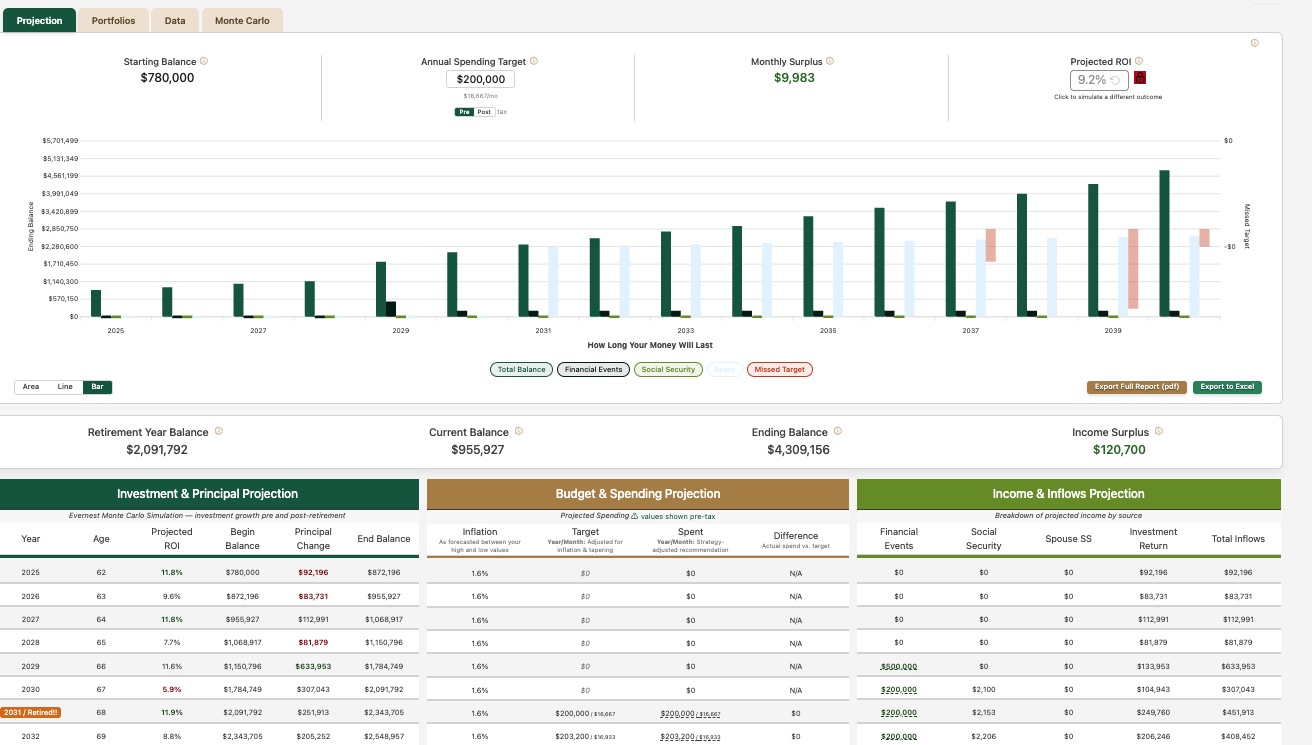
Spending is usually the most powerful lever. A $5,000 annual reduction in spending doesn't just save $5,000 per year — it also preserves $5,000 in your portfolio that continues earning returns. Over 25 years, this compounds to an extra $250K–$350K in portfolio value if that money stays invested at 5–8% ($125K in spending, not counting growth).
Social Security is the second-biggest factor for most people. Every dollar of Social Security income is a dollar you don't withdraw from your portfolio. A $24,000 annual benefit effectively extends your portfolio's life by years because it reduces the annual withdrawal pressure.
Returns and time form the other half of the equation. Higher returns extend longevity; longer retirements stress it. The difference between 5% and 7% average returns can add or subtract five to eight years of portfolio life. And retiring at 60 instead of 65 adds five years of withdrawals and removes five years of accumulation — a ten-year swing in financial pressure.
Extend Your Money's Lifespan
When the initial projection shows your money running out too early, you have several levers to pull. Evernest lets you test each one and see the exact impact on your savings longevity.
Taper spending is often the easiest win. Instead of assuming flat spending at $55,000 for 30 years, model spending that starts at $55,000 and gradually decreases to $40,000 by age 85. This reflects how most retirees actually spend and can extend a portfolio by roughly 8–12 years in our examples without requiring any immediate lifestyle change.
Delaying Social Security is another powerful move. The larger monthly benefit from waiting until 70 reduces your annual portfolio withdrawals permanently, which compounds over decades. And part-time work in early retirement — even modest income of $10,000- $15,000 per year — can dramatically reduce early withdrawal pressure when your portfolio is most vulnerable.
Frequently Asked Questions
How long will $500,000 last in retirement?
It depends on spending, income, and returns. With $50,000 annual spending, no other income, and 5% returns, $500,000 lasts roughly 13 years. Add $24,000 in Social Security and it extends to 30+ years. Evernest models every variable together for your specific situation.
What can I do if my savings won't last?
The most impactful changes: reduce spending by $3,000-$5,000/year (adds 5-8 years), delay retirement 1-3 years, delay Social Security for a larger benefit, add part-time income early, or use taper spending that gradually decreases with age.
What age should I plan to?
Planning to 90 covers most people, but 95 provides a safety margin. If you have family longevity, plan longer. The cost of planning to 95 instead of 90 is often just a modest spending reduction — a small price to avoid outliving your money.
Related Resources
How Long Will My Money Last?
Year-by-year projections showing your portfolio's lifespan.
Safe Withdrawal Rate Calculator
Find the withdrawal rate that keeps your money lasting.
Retirement Spending Planner
Find your sustainable spending level with taper strategies.
Retirement Withdrawal Calculator
Test different withdrawal strategies year by year.
How Long Will Your Savings Last?
See exactly which year your money runs out — or confirm it lasts a lifetime. Test changes and find the plan that gives you lasting security.
No credit card required · No signup needed for demo