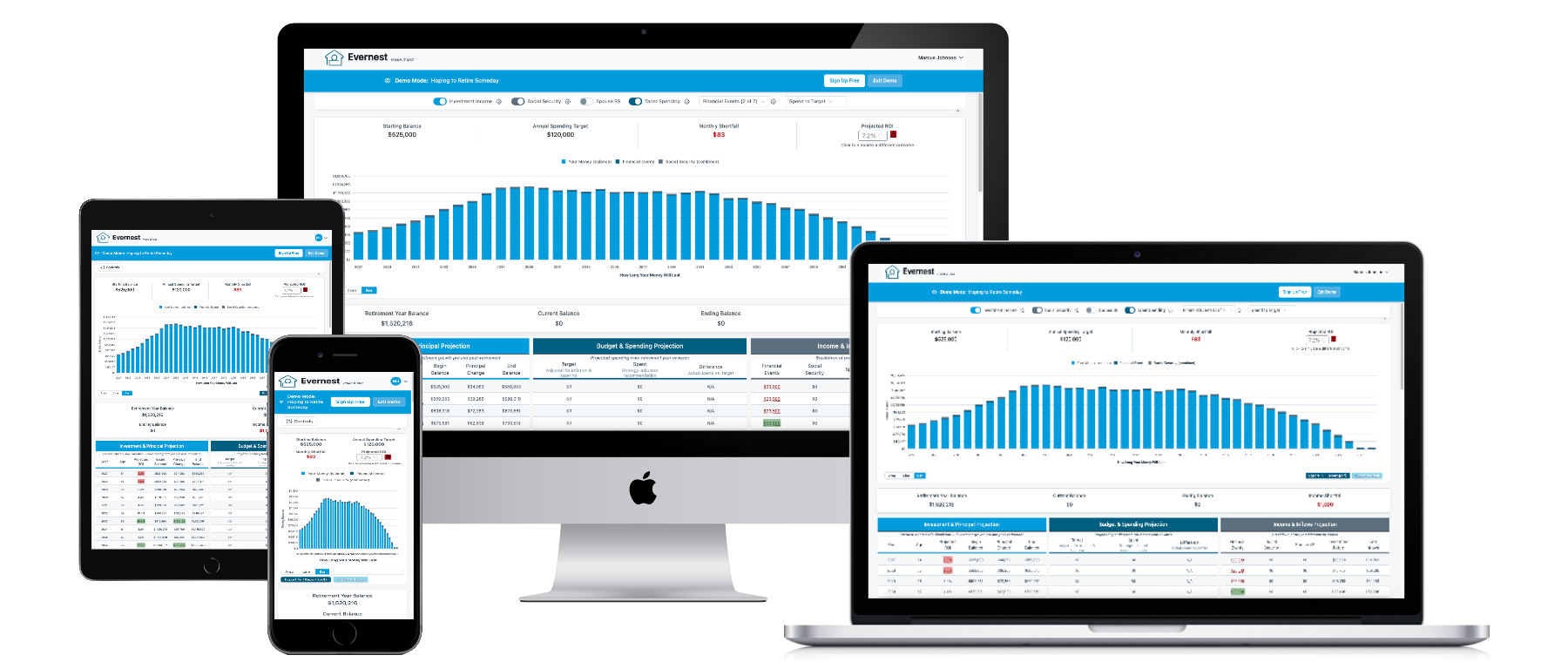
Know When You're Ready to Retire
"When can I retire?" is the question that keeps more people up at night than any other financial question. And it's not because the math is impossibly complex — it's because most people have never seen the math done with their actual numbers. They've read articles about saving 10x or 25x their salary, but those generic rules don't account for Social Security timing, taper spending, portfolio allocation, part-time income, or any of the other factors that make every person's retirement date different.
The real answer to "when can I retire?" requires projecting your finances forward from today through age 90 or beyond. You need to know: if I stop working at age X, will my savings plus Social Security plus any other income cover my spending until I die? That's not a question a rule of thumb can answer. It's a question that requires running the numbers year by year — which is exactly what Evernest does.
When you enter your financial information into Evernest, the software builds a complete projection for every year of your retirement. You can see your portfolio balance, your income from all sources, your annual spending, and the gap between income and spending that your portfolio must cover. If your money lasts through age 95 under conservative assumptions, you can retire with confidence. If it runs out at 78, you know exactly how much more you need to save — or how many more years you need to work.
Estimate Your Retirement Timeline
Your retirement timeline isn't a single date — it's a range of possible dates, each with different financial implications. Most people can construct three meaningful scenarios: an optimistic date (the earliest they could retire if things go well), a conservative date (when they're comfortable under pessimistic assumptions), and a realistic date (the sweet spot between the two).
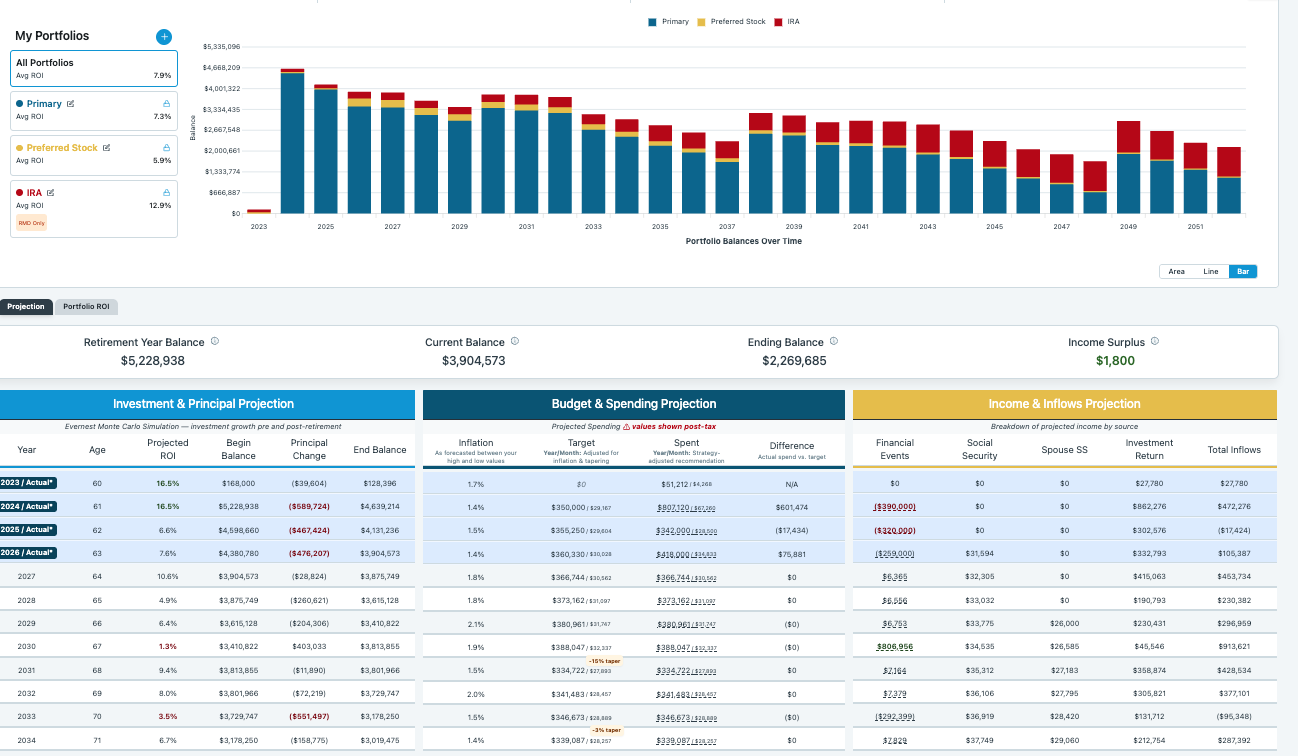
Building these scenarios is straightforward with Evernest. Start with your current savings, annual contributions, expected spending, and Social Security estimates. Set your retirement age to 62 and look at the projection — does your money last? If not, try 63. Then 64. Each additional year of work adds to your savings, adds investment growth, and removes a year of withdrawals. At some point, the projection crosses from "money runs out" to "money lasts." That crossing point is your earliest viable retirement date.
But viability isn't the same as comfort. You might find that your money technically lasts at 62, but with almost no cushion — any unexpected expense or market downturn would push you over the edge. Working two more years might transform that razor-thin projection into a comfortable one. Understanding this continuum — from barely viable to comfortably funded — is what separates real retirement planning from guesswork.
Test Different Retirement Dates
Each year of work affects your retirement finances in three compounding ways. First, you contribute more to your savings — even $15,000-$25,000 per year adds up significantly. Second, your existing portfolio grows for one more year — at 6% returns, a $500,000 portfolio earns $30,000 in a single year. Third, you need your money to last one fewer year — retiring at 65 instead of 64 removes an entire year of withdrawals from your plan.
The combined impact of these three factors is why retirement date is usually the single most powerful variable in your plan. Someone with $400,000 at age 60 who saves $20,000 per year (at year end) and earns 6% will have roughly $491,000 at 62, $593,000 at 64, and $707,000 at 66. The difference between retiring at 62 and 66 isn't just $216,000 more in savings — it's also four fewer years of withdrawals, which can mean the difference between running out at 82 and having a healthy balance at 95.
Evernest makes this comparison instant. Change your retirement age and the entire 30-year projection updates in real time. You can watch the portfolio balance curve shift as you move the date forward or backward, and you can pinpoint exactly which retirement age gives you the combination of lifestyle and security you're looking for.
Understand How Timing Changes Everything
Retirement timing interacts with every other decision in your plan. When you retire affects when you need to claim Social Security, how long your portfolio must sustain withdrawals, whether you can bridge with part-time work, and how much spending flexibility you have. Change the retirement date and all of these other variables shift.
Consider early retirement at 58. You're seven years away from Medicare (health insurance costs spike), nine years from full Social Security, and twelve years from the maximum Social Security benefit. Your portfolio must fund everything during those gap years — spending, health insurance, and the opportunity cost of missing Social Security income. For many people, the gap years are the most financially stressful period of retirement, and they last longer the earlier you retire.
Now consider retiring at 65. Medicare starts immediately, eliminating the health insurance gap. Social Security is available in two years (or now, if you claimed at 62). Your portfolio has had seven more years of growth and contributions. The financial pressure is dramatically lower, and your plan has far more margin for error.
Neither date is inherently "right." Some people have enough savings that the gap years are easily funded, and seven extra years of freedom easily justify the cost. Others find that two more years of work transforms an anxious retirement into a comfortable one. The only way to know which camp you're in is to model both options with your real numbers.
Plan Your Retirement With Confidence
Confidence in your retirement date comes from data, not optimism. When you've modeled your retirement at three different ages and seen the projections under conservative assumptions, you know what's possible. You're not hoping your money will last — you've seen the year-by-year trajectory and you understand the mechanics.
Evernest gives you this confidence for free. Create an account, enter your current savings, annual contributions, expected spending, and Social Security estimates, and the software builds a complete projection in seconds. Test retirement at 60, 62, 65, 67 — each scenario takes about ten seconds to configure and the projection updates instantly.
Within thirty minutes, you'll have a clearer picture of your retirement timeline than most people get from years of wondering. You'll know the earliest date you can retire, the date where you're comfortably funded, and exactly how many years of security each additional year of work buys you. That's not just planning — it's peace of mind backed by real numbers.
Frequently Asked Questions
How do I know if I have enough to retire?
You have enough to retire when your savings, combined with Social Security and other income, can fund your spending needs for the rest of your life. Rules of thumb like "save 25 times your annual spending" give a rough target, but the real answer depends on your specific income sources, spending plan, and retirement age. Evernest shows you year by year whether your money lasts — no rules of thumb needed.
Can I retire at 55?
Early retirement at 55 is possible but requires careful planning. You'll face 7-12 years without Social Security, meaning your portfolio must fund 100% of your spending during that period. You'll also need to cover health insurance until Medicare kicks in at 65. Evernest lets you model retirement at 55 with your actual numbers so you can see whether your savings can handle the extended timeline.
How much does one more year of work change my retirement?
One more year of work typically provides three benefits: an additional year of savings contributions, an additional year of investment growth on your existing portfolio, and one fewer year of withdrawals. The combined effect varies by situation, but for many people one extra year of work adds 2-4 years of financial security in retirement. Evernest shows you the exact impact by letting you compare retirement at different ages.
What is the best age to retire?
There's no universally best age — it depends on your savings, income sources, spending needs, health, and personal priorities. Financially, working longer almost always improves your outlook. But retirement is about more than money — health, relationships, and quality of life matter too. The best approach is to model several ages with your actual numbers and find the earliest date where you're financially comfortable.
Related Resources
Do I Have Enough to Retire?
Year-by-year projections showing whether your savings will last through retirement.
Retirement Scenario Planning Tool
Compare multiple retirement dates and scenarios side by side.
Social Security Planning Calculator
Find the best claiming age for your situation with year-by-year projections.
Retirement Planning Software
Comprehensive retirement modeling with full financial projections.
Find Your Retirement Date
Test retirement at different ages and see exactly how each year of work changes your financial future. Get your answer in minutes, not months.
No credit card required · No signup needed for demo