Estimate Your Retirement Income
Retirement income isn't a single number — it's a changing stream that evolves as you age. At 62, your income might come entirely from portfolio withdrawals and part-time work. At 67, Social Security starts and your portfolio withdrawals drop. At 70, a delayed Social Security benefit kicks in at full value. At 75, part-time work ends. Each transition changes your financial picture, and understanding these shifts is essential for planning a retirement that doesn't run out of money.
Most retirement income calculators give you a snapshot — your estimated income at retirement age. That's useful but incomplete. What you really need is a timeline: your income at 65, at 70, at 75, at 80, at 85. Because the income mix changes at each stage, and the gaps between income and spending create the withdrawal pressure that determines whether your portfolio survives.
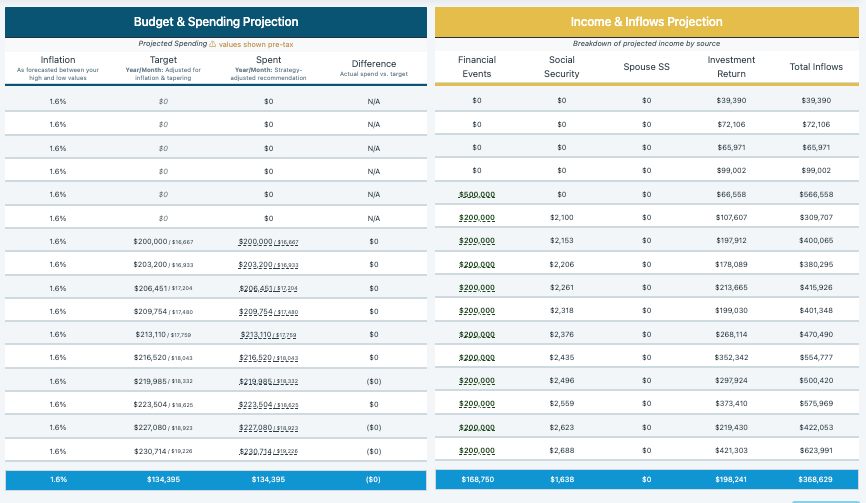
Evernest builds this timeline automatically. Enter each income source — Social Security, pensions, part-time work, rental income — with its start date, amount, and duration. The software calculates your total income for every year, compares it against your spending, and shows you the income shortfall (or surplus) that your portfolio must absorb. The result is a complete picture of how money flows through your retirement, year by year.
Include Social Security and Investments
Social Security and investment income are the two pillars of most retirement income plans, but they work very differently. Social Security provides a guaranteed, inflation-adjusted income for life — the ultimate financial floor. Investment income (portfolio withdrawals) is flexible and controllable but draws down your savings over time.
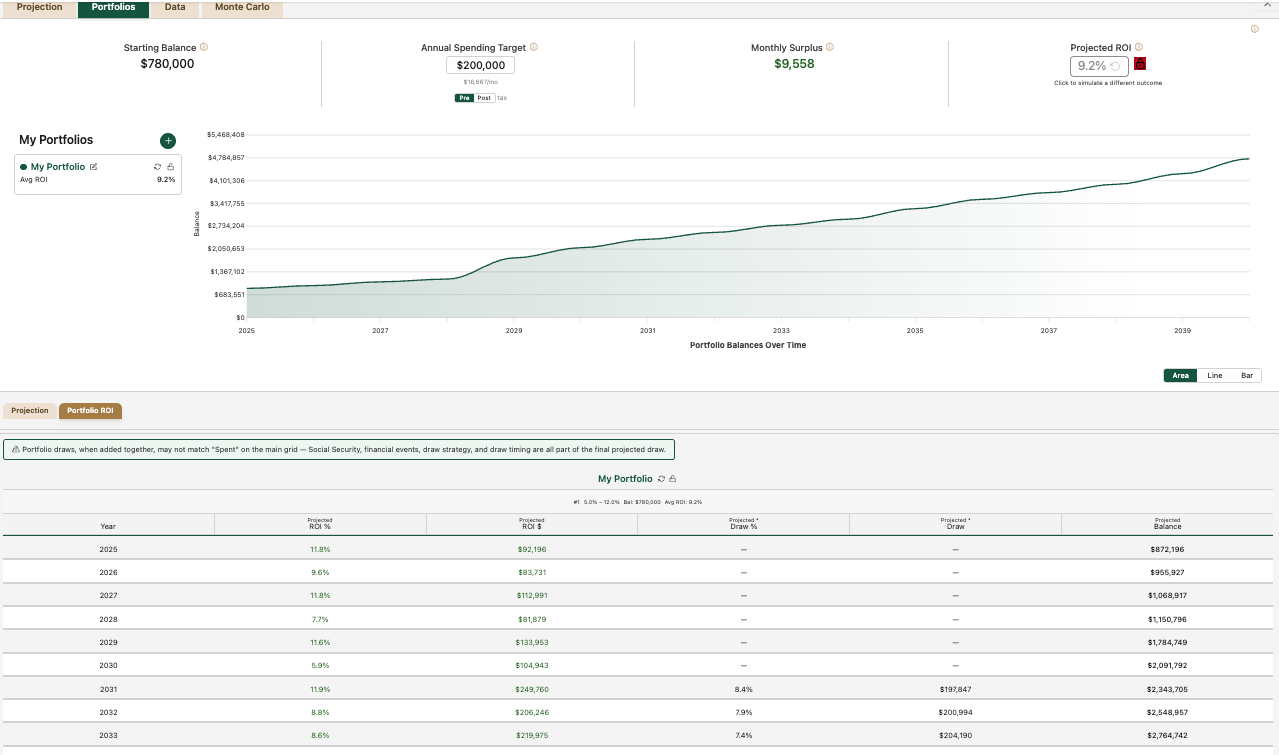
The interaction between these two sources is where strategy emerges. Before Social Security starts, your portfolio carries the full weight of your spending. After Social Security begins, the portfolio only needs to cover the gap. This creates a natural sequence: heavy portfolio withdrawals early, lighter withdrawals later. Understanding this sequence helps you assess whether your portfolio can survive the early years when it's doing all the work.
Evernest models both sources together so you can see the interaction. Your Income & Inflows projection shows Social Security, pensions, and other income stacking up year by year, while your Investment & Principal projection shows how portfolio withdrawals fill the remaining gap. When Social Security starts (or increases if you delayed), you can see the portfolio withdrawal rate drop — often dramatically — as the guaranteed income takes over more of the spending burden.
Test Different Income Strategies
Your income in retirement isn't fixed — it's a set of decisions. When you claim Social Security, how much you withdraw from your portfolio, whether you take on part-time work, and how you sequence these decisions can shift your lifetime income by hundreds of thousands of dollars.
Consider the Social Security decision alone. Claiming at 62 gives you eight extra years of income compared to waiting until 70. But the monthly benefit at 70 is 77% larger than at 62 — every month, for life, with cost-of-living adjustments on the larger base. The break-even point is typically around age 80–81. Live beyond 81, and delaying was the clear winner. The challenge is that during the eight waiting years, your portfolio must fund the gap — and that drawdown might compromise your portfolio's ability to sustain you later.
Evernest lets you test these strategies instantly. Change your Social Security claiming age and watch the entire income timeline shift. Add part-time work for the first five years of retirement and see how it bridges the gap before Social Security starts. Model rental income from a property and see how it reduces your portfolio withdrawal needs. Each change recalculates every year of your projection.
The goal isn't to maximize income in any single year — it's to build an income strategy that sustains your spending needs for 25-35 years while preserving enough portfolio balance to handle surprises. That requires seeing the full timeline, not just a single year's income estimate.
Plan for Long-Term Financial Security
Long-term financial security in retirement means having enough income to cover your spending for as long as you live — typically through age 90, 95, or even 100 for conservative planning. The biggest threat to long-term security isn't a market crash or unexpected expense — it's the slow erosion of purchasing power through inflation and the steady drawdown of portfolio assets through withdrawals.
This is why income planning matters more than just knowing your portfolio balance. A $500,000 portfolio sounds like a lot at 65, but if you're withdrawing $40,000 per year and only earning 5% returns, the math isn't in your favor over 30 years. Add $24,000 per year in Social Security starting at 67, and suddenly your portfolio only needs to cover $16,000 per year in shortfall — a rate that makes $500,000 last decades longer.
Evernest's income shortfall metric makes this dynamic visible. For every year of your retirement, you can see the gap between your total income and your total spending. When the shortfall is small, your portfolio barely shrinks. When it's large, you're drawing down fast. Watching this metric year by year reveals exactly which periods of retirement create the most financial pressure — and which income strategy decisions reduce that pressure most effectively.
Build Your Retirement Plan Today
Your retirement income plan starts with understanding what you have. Gather your most recent Social Security statement (available at ssa.gov), check your pension benefits if applicable, total up your retirement accounts, and estimate your annual spending. With those four numbers, Evernest can build a complete income projection for every year of your retirement.
Create a free account to get started — no credit card required. Within minutes, you'll see exactly how much income you'll have at each stage of retirement, where the gaps are, and which strategy changes could close them. It's the clearest picture of your retirement income you've ever had, and it's free.
Frequently Asked Questions
How do I estimate my total retirement income?
Add up all income sources: Social Security benefits, pension payments, portfolio withdrawals, part-time work, rental income, and any other recurring income. Evernest calculates this for every year of your retirement, showing you not just your income at 65 but at 70, 75, 80, and beyond — because your income mix changes as sources start and stop.
What counts as retirement income?
Retirement income includes Social Security benefits, pension payments, 401(k) and IRA withdrawals, investment dividends, rental income, part-time or freelance earnings, annuity payments, and any other regular cash flow. Evernest lets you model each source with its own start date, amount, and duration so you can see how your total income changes over the course of retirement.
How much retirement income do I need?
The common rule of thumb is 70-80% of your pre-retirement income, but the actual answer depends on your specific spending plans, debt situation, and lifestyle goals. Some retirees spend more than they earned while others spend significantly less. Evernest takes the opposite approach: instead of guessing what percentage you'll need, you enter your actual spending target and the software calculates whether your income sources cover it.
What happens when a retirement income source runs out?
When an income source ends — part-time work stops, a pension term expires, or your portfolio is depleted — the gap must be covered by other sources or reduced spending. Evernest's year-by-year projection shows exactly when each income source starts and stops, and how the loss of any source affects your overall financial picture. This helps you plan for income transitions before they happen.
Related Resources
Retirement Income Planning Software
Build a complete income plan combining all your retirement income sources.
Social Security Planning Calculator
Find your best claiming strategy and maximize your lifetime benefits.
Retirement Withdrawal Calculator
Test different withdrawal rates and see how long your portfolio will last.
Retirement Cash Flow Calculator
Forecast the flow of money in and out of your retirement accounts year by year.
See Your Retirement Income Picture
Estimate income from every source — Social Security, investments, pensions, and more. See how it all adds up, year by year, for the full length of your retirement.
No credit card required · No signup needed for demo