Why Distribution Order Matters
Most retirees have savings in multiple account types: taxable brokerage accounts, tax-deferred accounts (traditional 401(k)s and IRAs), and potentially tax-free accounts (Roth IRAs). Each account type is taxed differently when you withdraw, and the order in which you draw from them affects your total tax bill over the course of retirement.
The conventional approach — draw from taxable first, then tax-deferred, then Roth — isn't always optimal. If you have a large traditional IRA, letting it grow untouched until RMDs begin (73 if born 1951–1959, 75 if born 1960 or later) can create a tax bomb: forced withdrawals that push you into higher brackets, trigger Social Security taxation, and increase Medicare premiums.
Strategic distribution planning considers the full picture — your current bracket, future RMDs, Social Security taxation thresholds, and the long-term growth potential of each account type. Sometimes paying a little more tax now (through early traditional withdrawals or Roth conversions) saves significantly more later.
Plan Around Required Minimum Distributions
RMDs are the biggest wild card in distribution planning. RMDs begin at 73 if you were born 1951–1959, and 75 if born 1960 or later. From then on, the IRS requires you to withdraw a minimum amount from traditional retirement accounts each year. The percentage increases as you age, and the withdrawals are fully taxable.
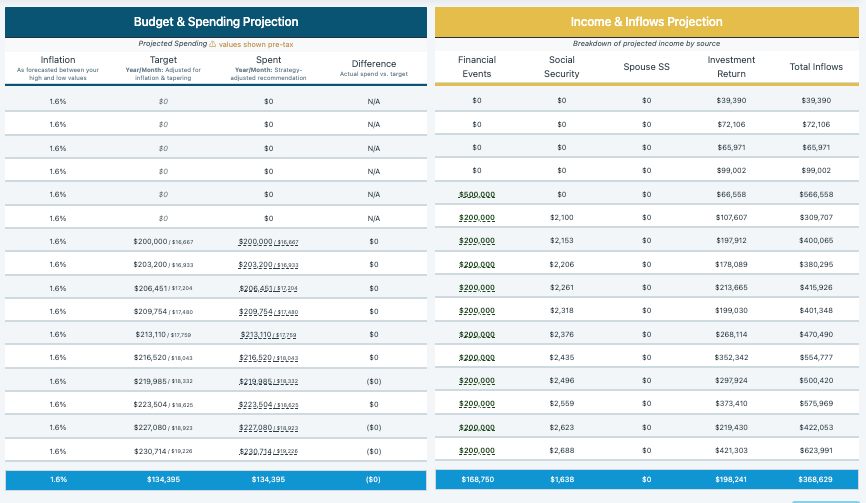
For someone with $800,000 in a traditional IRA at 73, the first RMD is roughly $30,000. By 80, it grows to roughly $38,000. By 85, roughly $47,000. These mandatory withdrawals stack on top of Social Security and any other income, potentially pushing you into the 22% or 24% bracket even if your voluntary spending is modest.
The window between retirement and your first RMD (73 if born 1951–1959, 75 if born 1960 or later) is your opportunity to manage this. Roth conversions, strategic early withdrawals, or a combination can reduce your traditional balance before RMDs begin, giving you more control over your taxable income for the rest of your life. Evernest isn't a tax tool: it lets you view your spending pre-tax or post-tax using a tax rate you enter, but it doesn't calculate your taxes or optimize Roth conversions — for that, use a CPA or a dedicated tax tool.
Model Your Distribution Strategy
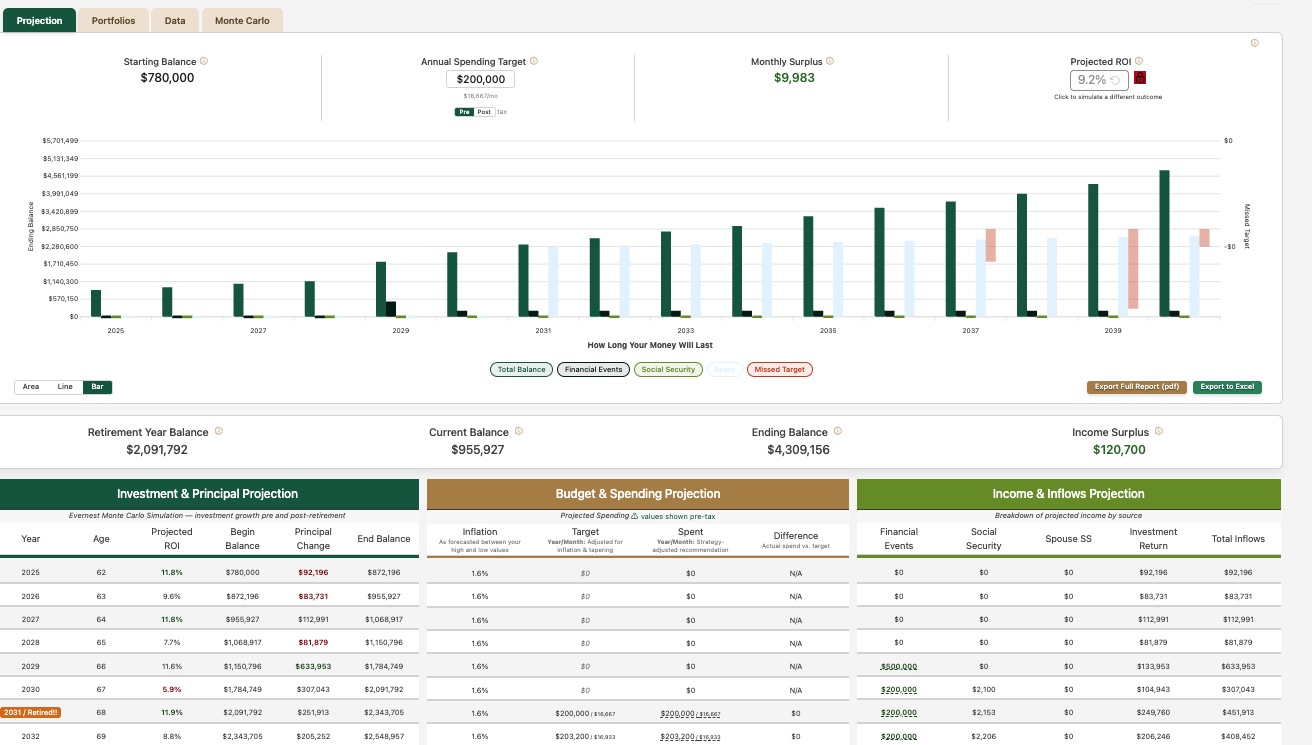
Evernest shows you how your portfolio balance, income, and withdrawals interact over 30+ years. By modeling different withdrawal sequences, you can compare their long-term effects on your total portfolio and identify the strategy that preserves the most wealth.
Test the conventional approach against a more strategic one. Compare drawing $40,000 per year from your traditional IRA starting at 62 (paying tax at 12-22%) versus waiting until RMDs begin (73 or 75, depending on birth year) and force $30,000+ in taxable withdrawals on top of your Social Security (potentially at 24%+). Evernest shows how each draw order affects your portfolio balances year by year; for the tax side of that comparison, use a CPA or a dedicated tax tool.
The right strategy balances after-tax income against portfolio growth. Evernest shows the portfolio side of that balance; a CPA or a dedicated tax tool can show the tax side.
Frequently Asked Questions
What order should I withdraw from retirement accounts?
The conventional order is taxable first, then tax-deferred, then Roth. But the optimal order depends on your tax brackets, Social Security, and RMD situation. Sometimes drawing from traditional accounts earlier reduces future RMDs and overall lifetime taxes.
What are required minimum distributions (RMDs)?
RMDs are mandatory annual withdrawals from traditional retirement accounts. RMDs begin at 73 if you were born 1951–1959, and 75 if born 1960 or later. The amount is based on your balance and life expectancy factor. They're taxed as ordinary income and can push you into higher brackets. Roth IRAs have no RMDs.
How can I reduce my required minimum distributions?
Reduce your traditional account balance before RMDs begin (73 if born 1951–1959, 75 if born 1960 or later) through Roth conversions or strategic early withdrawals during low-income years. Evernest isn't a tax tool: it lets you view your spending pre-tax or post-tax using a tax rate you enter, but it doesn't calculate your taxes or optimize Roth conversions — for that, use a CPA or a dedicated tax tool.
Related Resources
Plan Your Distributions
Model the draw order across your portfolios and see how distribution timing affects your portfolio and long-term financial security over 30+ years.
No credit card required · No signup needed for demo