Find Your Best Claiming Strategy
Social Security is one of the largest financial decisions you'll make in retirement, yet most people give it surprisingly little analysis. The Social Security Administration lets you claim benefits as early as 62 or as late as 70, and each year you wait past full retirement age increases your monthly benefit by 8% per year (until 70). That's a guaranteed return you won't find anywhere else — but it comes with a real cost: years of foregone income while you wait.
The right claiming age depends on your complete financial picture. How much do you have saved? What are your annual spending needs? Do you have other income sources that can bridge the gap while you delay? How's your health, and what's your family history of longevity? These questions don't have textbook answers — they have personal answers that depend on your specific numbers.
A Social Security planning calculator helps you move past rules of thumb and into real analysis. Instead of hearing "delay if you can" or "take it early if you need it," you can model both options with your actual savings, spending, and income — and see which one keeps your money lasting longer.
Compare Claiming Ages
The math behind Social Security timing is deceptively complex. Claiming at 62 means eight years of income before someone claiming at 70 receives their first check. But the person claiming at 70 receives a monthly benefit that's 77% larger — every month, for the rest of their life, with cost-of-living adjustments on the larger base.
The "break-even age" — when the total dollars received from the delayed claim overtake the early claim — typically falls about 78–79 for 62 vs 67, 80–81 for 62 vs 70, and 82–83 for 67 vs 70. If you live past the break-even point, delaying was the better financial choice. If you don't, claiming early gave you more total income.
But break-even analysis alone misses the bigger picture. Social Security isn't your only income source — it interacts with your portfolio withdrawals, your spending needs, and your other income. Claiming early means smaller Social Security checks but lower portfolio withdrawals in your 60s. Claiming late means larger Social Security checks but higher portfolio withdrawals for up to eight years while you wait. The net effect on your total retirement plan depends on everything working together.
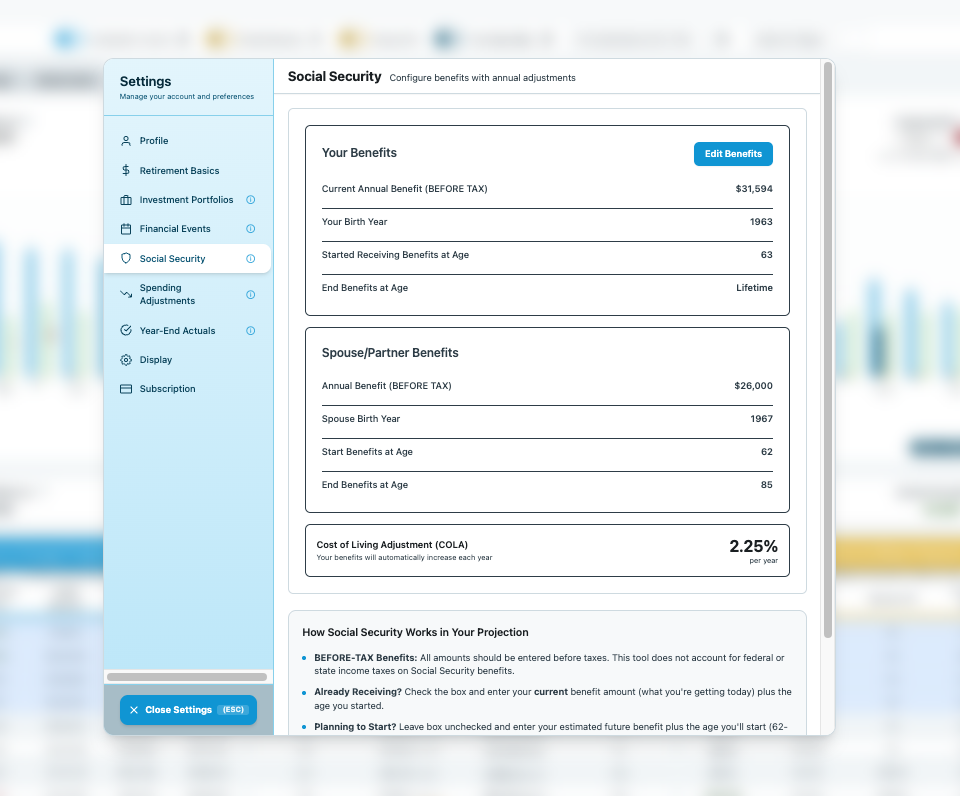
Evernest shows you this complete picture. When you change your Social Security claiming age, the entire projection recalculates — portfolio withdrawals, income shortfalls, and your year-by-year balance all update instantly. You don't just see the Social Security numbers in isolation; you see how they affect everything else.
Understand the Impact on Retirement Income
Social Security's impact on your retirement extends far beyond the monthly check. Consider the income shortfall — the gap between what you spend each year and what your non-portfolio income covers. When Social Security starts, that gap shrinks dramatically. Before Social Security, your portfolio may need to fund 100% of your spending. After Social Security kicks in, your portfolio might only need to cover 30-50% of spending, depending on your benefit level.
This dynamic creates a natural sequence in most retirement plans: a "red zone" of high portfolio withdrawals before Social Security starts, followed by a more sustainable period where Social Security covers a large portion of spending. The size of the red zone depends directly on when you claim. Claim at 62 and the red zone might be zero (if you retire at 62). Claim at 70 and you might face eight years of heavy portfolio withdrawals — but those eight years buy you a permanently larger income floor for the next 20-30 years.
For couples, the strategy gets even more interesting. The higher earner's Social Security benefit also determines the survivor benefit — the amount the surviving spouse receives after one partner passes away. Maximizing the higher earner's benefit by delaying to 70 doesn't just increase their income during their lifetime; it provides a larger safety net for the surviving spouse, potentially for decades. Evernest models both partners' benefits and shows you the combined effect on your household finances year by year.
Test Different Social Security Scenarios
The best way to understand Social Security timing is to test multiple scenarios with your real numbers. Evernest makes this effortless — change your claiming age and watch the entire 30-year projection update instantly. Here are the scenarios worth testing:
Early claiming (62): Start with the earliest possible claiming age. This gives you the lowest monthly benefit but the longest collection period. Note how your portfolio balance changes — does starting Social Security early keep your portfolio healthier by reducing early withdrawals? Or does the smaller benefit create income shortfalls later that drain your portfolio faster?
Full retirement age (67): This is the baseline benefit without any reduction or increase. Compare it against 62 — how much does a benefit about 43% larger improve your long-term picture? Is the five-year gap worth bridging with portfolio withdrawals?
Maximum benefit (70): The largest possible benefit. Your monthly check is 77% larger than at 62 and 24% larger than at 67. But you need to bridge eight years without Social Security income. Model this scenario and pay close attention to your portfolio balance during those gap years. Does your portfolio survive the drawdown? If so, the larger benefit likely wins over the long term.
The answer that's right for you might surprise you. Some people with modest portfolios find that claiming early preserves their savings because the alternative — heavy withdrawals during the gap years — creates more risk than the smaller benefit. Others with larger portfolios find that delaying to 70 is a clear winner because the gap-year withdrawals barely dent their balance while the larger benefit dramatically reduces their long-term withdrawal needs.
Plan Smarter With Evernest
Social Security timing isn't a decision you make in isolation. It's woven into every other aspect of your retirement plan — your portfolio withdrawal strategy, your spending levels, your retirement date, and your overall income plan. Evernest brings all of these elements together in one projection so you can see how they interact.
Most Social Security calculators show you the benefit amounts in isolation: "$2,000 at 62 vs. $3,540 at 70." That's useful but incomplete. What you really need to know is how each option affects your total retirement — your portfolio balance at 80, your income shortfall at 75, whether your money lasts to 95. Evernest gives you that complete picture because Social Security is just one input in your full financial model.
Create your free account, enter your Social Security estimates (you can find these on your annual Social Security statement or at ssa.gov), and start testing claiming ages. Within minutes you'll have a clear picture of how each option affects your retirement — not just the Social Security dollars, but the complete cascade of effects on your portfolio, spending, and long-term financial security.
Frequently Asked Questions
When should I start taking Social Security?
The best claiming age depends on your health, other income sources, and retirement plans. Claiming at 62 gives you smaller monthly checks sooner, while waiting until 70 gives you the largest possible benefit — roughly 77% more than at 62. Evernest shows you the total lifetime impact of each option within the context of your complete financial picture.
How much does Social Security increase if I wait until 70?
Social Security benefits grow by approximately 8% for each year you delay past your full retirement age (66-67 for most people). Delaying from 62 to 70 increases your monthly benefit by roughly 77%. For someone with a $2,000 monthly benefit at 62, waiting until 70 would mean roughly $3,540 per month — an extra $18,480 per year for life.
Should my spouse and I claim Social Security at the same time?
Not necessarily. Many couples benefit from a split strategy where the higher earner delays to 70 (maximizing the larger benefit and the survivor benefit) while the lower earner claims earlier to provide household income during the gap years. Evernest lets you model different claiming ages for each spouse and see the combined effect on your retirement projections.
Does delaying Social Security always make financial sense?
Not always. Delaying makes the most sense if you expect to live into your 80s or beyond, have other income to bridge the gap, and don't need the money immediately. If you have health concerns, no other income sources, or significant debt, claiming earlier might be the better choice. The key is modeling both options with your actual numbers — Evernest shows you the break-even point and the long-term impact.
Related Resources
When Should I Take Social Security?
Deep dive into Social Security timing with real-world claiming strategies.
Retirement Income Planning Software
Build a complete income plan combining Social Security, investments, and pensions.
Retirement Income Calculator
Estimate your total retirement income from every source, year by year.
Retirement Planning Software
Comprehensive retirement modeling with full financial projections.
Find Your Best Claiming Strategy
See how claiming at 62, 67, or 70 affects your complete retirement picture. Model spousal strategies and find the approach that keeps your money lasting longest.
No credit card required · No signup needed for demo