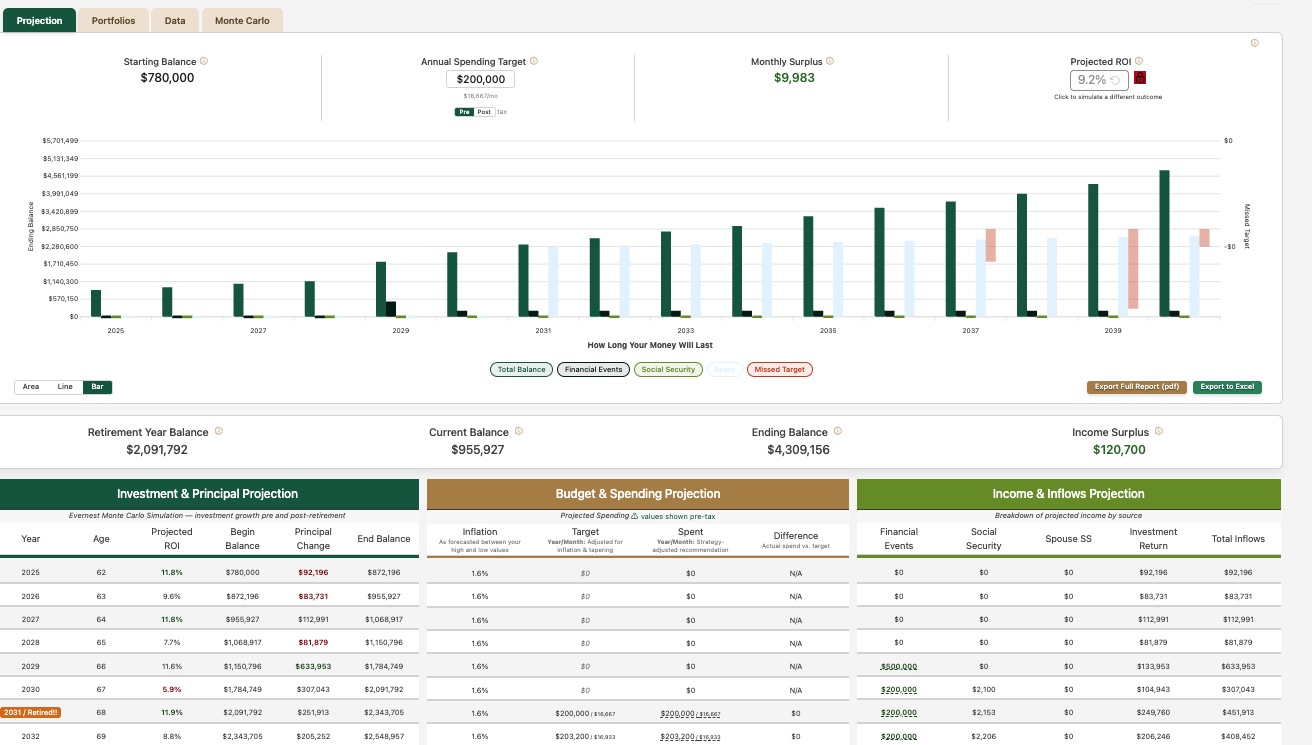
Forecast Your Retirement Cash Flow
Retirement changes the fundamental way money works in your life. Instead of a single paycheck arriving every two weeks, you're managing multiple income streams that start and stop at different times — Social Security at 67, your spouse's at 70, a pension at 62, consulting income from 63 to 66 — while spending shifts year by year as your lifestyle evolves.
A retirement cash flow calculator maps all of this complexity into a single timeline. For every year of your retirement, you see exactly how much is coming in, how much is going out, and whether your portfolio is growing or shrinking. The difference between a year where income exceeds spending and a year where it doesn't is the difference between your money compounding in your favor and your savings being drawn down.
Evernest builds this cash flow projection automatically. Enter your income sources with their start dates and amounts, set your spending target, and the software generates a complete year-by-year forecast. You see your projected balance at every age, the income shortfall (or surplus) for each year, and the cumulative effect of every dollar flowing in and out over decades. It's the financial equivalent of a weather forecast — except instead of predicting rain, you're predicting whether your money will be there when you need it.
Balance Income, Spending, and Savings
The three pillars of retirement cash flow — income, spending, and savings — are constantly interacting. When your income exceeds your spending, the surplus stays invested and compounds. When spending exceeds income, you withdraw from savings, and the reduced balance generates less growth going forward. These compounding effects are small in any single year but transformative over a 30-year retirement.
This is why timing matters so much in retirement planning. Delaying Social Security from 62 to 70 means eight years of higher portfolio withdrawals — but then permanently higher income that may eliminate withdrawals entirely. Selling your home at 72 injects a lump sum that reduces withdrawals for years. Starting part-time work at 63 bridges the gap until pension income begins at 65. Each of these timing decisions creates a ripple effect through every subsequent year of your cash flow.
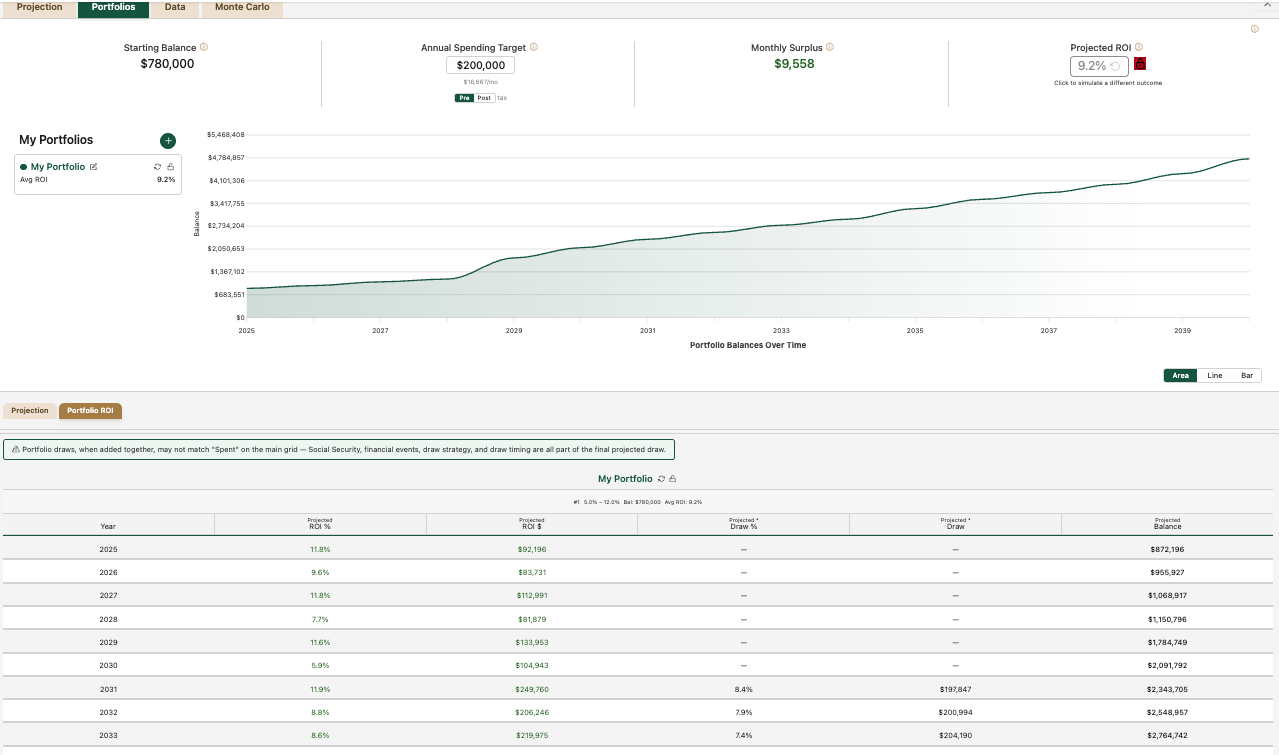
Evernest's projection table separates your finances into three clear views. The Investment & Principal Projection tracks your portfolio — beginning balance, returns, withdrawals, and ending balance for each year. The Budget & Spending Projection shows your annual target, any taper adjustments, and the difference between planned and actual spending. The Income & Inflows Projection breaks down every income source by year: Social Security, spousal Social Security, pensions, investment income, and scheduled financial events. Together, these three views give you complete visibility into how cash flows through your retirement.
Explore Real-Life Retirement Scenarios
Real retirement doesn't follow a straight line, and your cash flow calculator shouldn't either. Evernest lets you model the events and decisions that actually shape your financial future — not just the averages.
Consider a couple with $500,000 saved, planning to retire at 63. She starts Social Security at 67, he waits until 70. They spend $55,000 per year initially but plan to taper spending by 1.5% annually after age 75. At 73, they sell their house and downsize, netting $200,000. He does part-time consulting from 63 to 67, earning $25,000 per year.
A simple calculator can't model this. It would take the $500,000, apply a withdrawal rate, and give you a number. But the reality is that their cash flow looks completely different at age 64 (high spending, consulting income, no Social Security) than at age 74 (lower spending, both Social Security checks flowing, house sale proceeds invested) than at age 84 (minimal spending, full income coverage, portfolio barely touched).
Evernest models every phase of this timeline simultaneously. You see the lean early years where withdrawals are highest, the inflection point where Social Security starts covering most expenses, and the comfortable later years where income exceeds spending and the portfolio actually grows. This is what cash flow planning looks like when it's done right — not a single number, but a complete financial narrative that changes chapter by chapter.
Why Cash Flow Matters in Retirement
Net worth gets all the attention, but cash flow is what determines whether your retirement actually works. A person with $2 million and poor cash flow management can run out of money faster than someone with $800,000 and a well-structured income plan. The difference is understanding when money arrives, when it leaves, and how the gap between them compounds over time.
Cash flow visibility also reduces the emotional toll of retirement finances. When you can see that the high-withdrawal years between 63 and 67 are temporary — that Social Security will cut your withdrawal needs in half starting at 67 — a shrinking portfolio in those early years feels manageable rather than alarming. Without that visibility, every market dip triggers anxiety because you can't see the income that's coming.
This is why Evernest calculates your monthly income shortfall as a headline metric. At a glance, you know how much your spending exceeds your income — the amount that must come from your portfolio each month. Watching that number shrink as income sources come online is one of the most reassuring things you can see in retirement planning. Knowing that your shortfall drops from $3,000 per month at 63 to $400 per month at 70 tells you more about your retirement security than any single net worth number ever could.
Start Planning for Free
Evernest's cash flow projection tools are free to start using — no credit card, no commitment. Enter your basic financial information, configure your income sources and spending target, and see your complete retirement cash flow in minutes. The free plan includes the core projection engine, year-by-year timeline, and interactive charts.
Premium features — including extended projections, advanced spending strategies, and Excel/PDF export — are available when you're ready to go deeper. But the fundamentals of cash flow planning are yours from day one, because understanding how money flows through your retirement shouldn't require a subscription.
Frequently Asked Questions
What is a retirement cash flow calculator?
A retirement cash flow calculator projects your income and expenses year by year through retirement. Unlike a simple retirement calculator that gives you one number, a cash flow calculator shows you the flow of money in and out — Social Security, pensions, portfolio withdrawals, spending — for every year from retirement through age 100 and beyond.
Why is cash flow more important than net worth in retirement?
Net worth tells you what you have today. Cash flow tells you whether your money will last. A retiree with $1 million can run out of money in 15 years or fund 35 years of retirement — the difference is how income and spending flow year by year. Cash flow projections reveal the timing problems that a net worth snapshot hides.
What income sources should I include in my cash flow projection?
Include all sources: Social Security (yours and your spouse's, each starting at different ages), pensions, part-time work, rental income, annuities, and portfolio withdrawals. Evernest lets you schedule each income source with its own start and end dates so your projection reflects when money actually arrives.
Related Resources
Retirement Planning Software
Comprehensive retirement modeling with visual projections and scenario testing.
Retirement Withdrawal Calculator
Test different withdrawal rates and see how long your savings will last.
How Long Will My Money Last?
See the exact year your money might run out and strategies to extend it.
When Should I Take Social Security?
Compare claiming ages and see how timing affects your retirement cash flow.
See Your Retirement Cash Flow
Map every income source and expense across your retirement timeline. Know exactly when your money arrives, when it leaves, and whether the math works.
No credit card required · No signup needed for demo