Build a Reliable Retirement Income Plan
The shift from earning a paycheck to living on retirement income is one of the biggest financial transitions you'll ever make. For decades, money arrived on a predictable schedule — every two weeks, same amount, same source. In retirement, that single stream fractures into many: Social Security starting at one age, your spouse's at another, investment withdrawals sized to fill the gaps, maybe a pension, maybe consulting income for a few years.
The challenge isn't that any single income source is complicated. It's that they all interact. Delaying Social Security means larger checks later but bigger portfolio withdrawals now. Starting part-time work reduces your withdrawal needs but may affect when you claim benefits. A pension with a survivor benefit changes the math if your spouse outlives you. Each decision ripples through your entire income picture for years or decades.
Retirement income planning software exists to manage this complexity. Instead of tracking each income source in isolation — a Social Security estimator here, a withdrawal calculator there, a pension worksheet somewhere else — you model everything together in a single projection. When you change one variable, you see the effect on everything else immediately.
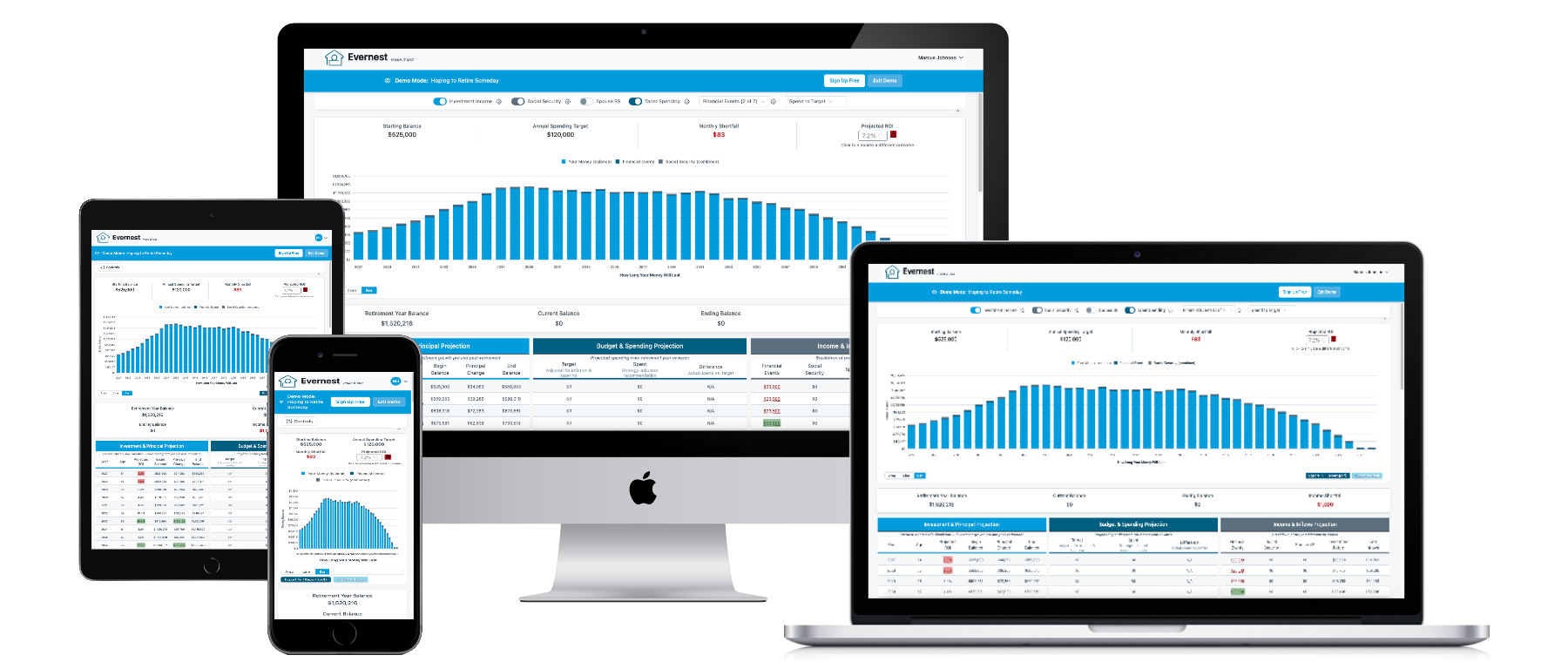
Evernest takes this approach to its logical conclusion. Every income source, every expense, every financial event lives on the same timeline. The software calculates your total income, total spending, and the gap between them for every year from now through age 100. You see not just whether you have "enough" in aggregate, but whether you have enough in each specific year — because a $50,000 shortfall at age 64 is a very different problem than one at age 84.
Plan Income From Every Source
A retirement income plan is only as good as its inputs. If you model Social Security but ignore the three years of consulting income that bridges the gap before it starts, your projection will show a crisis that doesn't actually exist. If you account for your pension but forget that it doesn't have a cost-of-living adjustment, your later years will look better on paper than they'll feel in practice.
Evernest's Income & Inflows Projection tracks every income source separately, each with its own timing and amount. Social Security is modeled with individual claiming ages for you and your spouse — set yours at 67 and your spouse's at 70, and the projection shows exactly how those staggered start dates affect your year-by-year cash flow. The software estimates your benefit at each claiming age based on the amounts you provide, so you can compare claiming at 62 versus 67 versus 70 and see the lifetime impact, not just the monthly difference.
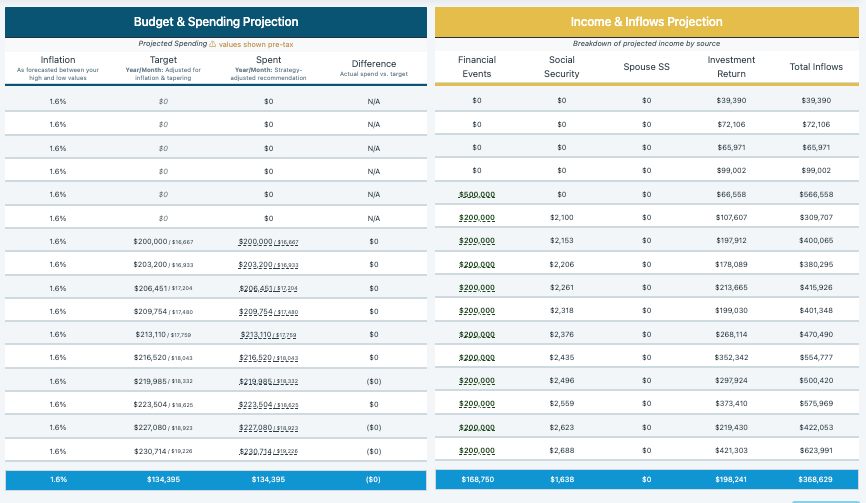
Financial events handle everything that doesn't fit a regular income pattern. A home sale at 73 that nets $250,000. An inheritance at 68. A lump-sum pension buyout at retirement. Part-time work from 62 to 66 earning $30,000 per year. Each event gets scheduled at a specific age, and the proceeds show up exactly where they belong in your timeline. The year you sell your house, your balance jumps; the years after, reduced housing expenses lower your spending needs. Both effects are captured automatically.
Portfolio withdrawals — the income you generate by drawing down your investments — are calculated as the residual. After all your other income sources are accounted for, Evernest shows you how much your portfolio needs to contribute each year to cover the remaining spending. In good years, when income exceeds spending, withdrawals are zero and the surplus stays invested. In lean years, withdrawals increase. Seeing this pattern across your full timeline reveals whether your portfolio is being asked to do too much, too early.
Model Retirement Decisions Before You Retire
The most valuable time to use retirement income planning software is before you retire. Once you've stopped working, many of your biggest decisions are already behind you. But in the five to fifteen years before retirement, you have enormous flexibility — and the decisions you make during this window have the largest impact on your income for decades.
The most obvious question is when to retire. Every additional year of work means one more year of savings, one more year of investment growth, one fewer year of withdrawals, and a higher Social Security benefit if you haven't claimed yet. But the relationship isn't linear — the value of each additional year depends on your specific situation. For some people, working one more year adds ten years to their portfolio's longevity. For others, it makes barely a difference because they're already well-funded. You can't know which camp you're in without modeling it.
Social Security timing is the second critical pre-retirement decision. The difference between claiming at 62 and 70 is roughly 77% in monthly benefit — but claiming early means more total checks over a shorter gap period. The break-even age where delayed claiming pays off depends on your other income, your portfolio size, and how long you live. Evernest shows you the cumulative effect, not just the monthly difference, so you can make this decision with full information.
Then there are the decisions that compound over time. Should you pay off the mortgage before retiring? That reduces monthly expenses but ties up cash. Should you convert traditional IRA funds to Roth while you're still working? The tax hit is real now, but the tax-free income later could be worth it. Should you take a lump-sum pension or the annuity? Each choice creates a different income pattern for the rest of your life. Modeling the income side of these choices before you commit — when you can still change course — is exactly what income planning software is built for. For the tax side of a Roth conversion, use a CPA or a dedicated tax tool.
See How Long Your Income Can Last
The fundamental question in retirement income planning is whether your income — from all sources combined — can sustain your lifestyle for as long as you need it. That's not a yes-or-no question. It's a year-by-year question with a different answer at every age.
At 63, your income might be just Social Security and portfolio withdrawals, covering 80% of your spending. At 67, your spouse's Social Security kicks in and you're at 95%. At 73, the house sale proceeds are invested and generating returns, and your tapered spending has dropped enough that income fully covers expenses. At 85, your spending is minimal, your income is stable, and your portfolio is actually growing again.
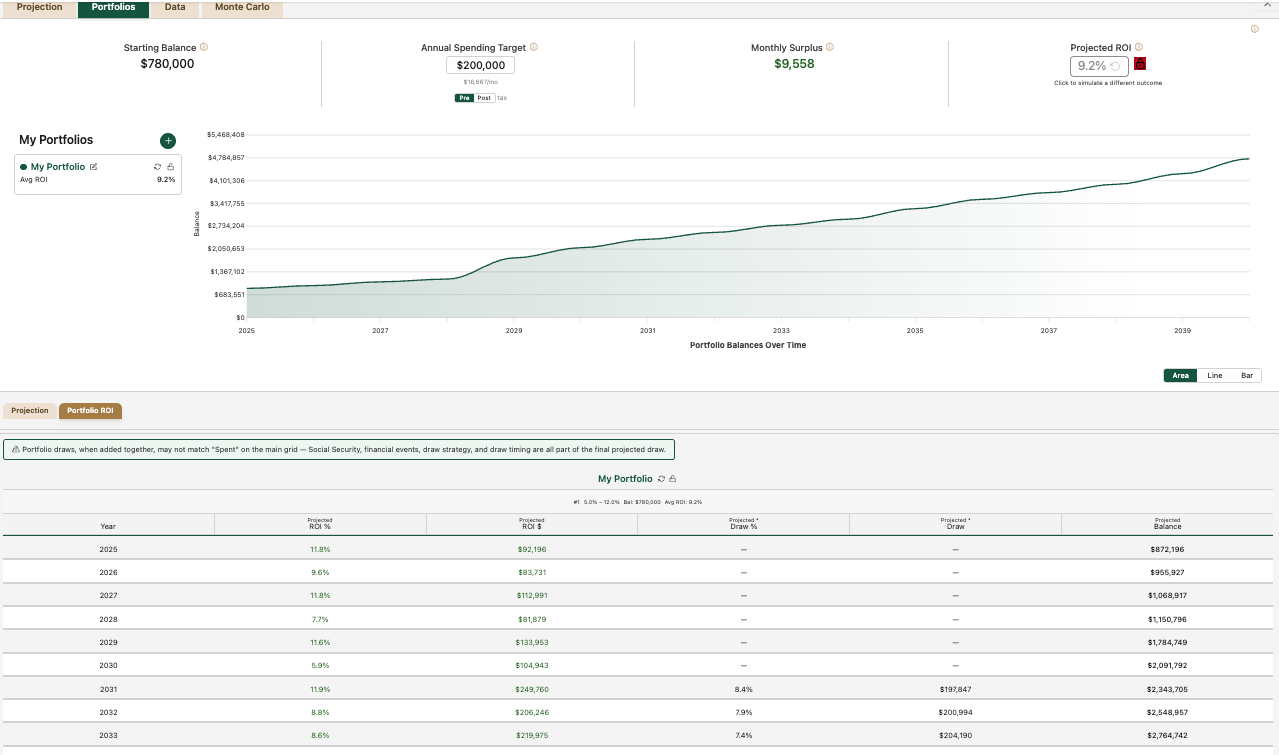
Evernest's charts make this trajectory immediately visible. The area chart shows your portfolio balance flowing through time — you can see the drawdown years, the stabilization point, and whether the balance stays positive through your entire planning horizon. The income shortfall metric tells you the monthly gap between income and spending at any point. And the projection tables give you the exact numbers for every year, so you can pinpoint the specific ages where income planning needs the most attention.
This level of detail is what separates income planning software from a retirement calculator. A calculator tells you whether you have "enough." Income planning software tells you whether you have enough at 65, at 72, at 80, and at 90 — and what to change if you don't. It's the difference between a pass/fail grade and a complete diagnostic.
Start Your Free Retirement Plan
Building a retirement income plan doesn't require a financial advisor or a complex spreadsheet. Evernest walks you through the setup in minutes: enter your current savings, set your retirement age, configure your Social Security and any other income sources, and set your spending target. The software builds your complete year-by-year projection immediately.
The free plan gives you access to the core income projection engine — Social Security modeling, financial event scheduling, interactive charts, and the full year-by-year timeline. Start with the basics, see your retirement income picture take shape, and explore premium features when you're ready to go deeper. Many users find that just seeing their income sources laid out on a timeline — with the gaps clearly visible — changes how they think about their retirement.
Your retirement income plan should be as unique as your retirement. Cookie-cutter calculators can't account for the specific combination of income sources, timing decisions, and life events that make up your financial future. Evernest can — and it starts for free.
Frequently Asked Questions
What is retirement income planning software?
Retirement income planning software helps you model all of your income sources — Social Security, pensions, investments, part-time work, rental income — together in a single timeline. It shows you how these sources combine year by year, where gaps exist between income and spending, and how timing decisions like when to claim Social Security affect your overall financial picture.
How do I create a retirement income plan?
Start by listing every income source you expect in retirement and when each one begins: Social Security (yours and spouse's), pensions, investment withdrawals, part-time work, rental income. Then set your annual spending target. Evernest combines all of this into a year-by-year projection that shows whether your income covers your expenses at every age — and what to adjust if it doesn't.
What income sources should I plan for in retirement?
The most common retirement income sources are Social Security, 401(k)/IRA withdrawals, pensions, and investment income. Many retirees also have part-time work income in early retirement, rental income, annuity payments, or one-time events like home sale proceeds or inheritances. A complete income plan accounts for all of these with their specific timing and amounts.
When should I start planning my retirement income?
Ideally 5-15 years before retirement, when your decisions have the most impact. But income planning is valuable at any stage — even people already in retirement benefit from modeling how their income sources will evolve over the next 20-30 years. The earlier you start, the more options you have to optimize timing and amounts.
Related Resources
Retirement Planning Software
Comprehensive retirement modeling with visual cash flow projections.
Retirement Cash Flow Calculator
Forecast income, spending, and savings year by year through retirement.
Retirement Withdrawal Calculator
Test different withdrawal rates and see how long your savings will last.
When Should I Take Social Security?
Compare claiming ages and see how timing affects your total retirement income.
Build Your Retirement Income Plan
Model every income source together. See exactly how Social Security, pensions, investments, and financial events combine — year by year through retirement.
No credit card required · No signup needed for demo