Why the 4% Rule Isn't Enough
The 4% rule was a groundbreaking insight when William Bengen published it in 1994. It answered a question retirees desperately needed answered: how much can I spend without running out? By back-testing against every 30-year period in US market history, Bengen found that a 4% initial withdrawal rate survived them all.
But the 4% rule makes assumptions that may not match your reality. It assumes a 30-year retirement (what if yours is 35 or 40?). It assumes your portfolio is your only income source (what about Social Security?). It assumes flat spending (what if you spend less as you age?). And it uses historical US returns that may not predict the next 30 years.
A safe withdrawal rate calculator goes beyond the rule by incorporating your actual financial situation. When you add Social Security starting at 67, the amount your portfolio needs to cover drops dramatically — and your sustainable withdrawal rate changes with it. When you model taper spending, your effective withdrawal rate decreases over time. These factors can shift your safe rate by 1-2 percentage points in either direction.
Find Your Personalized Rate
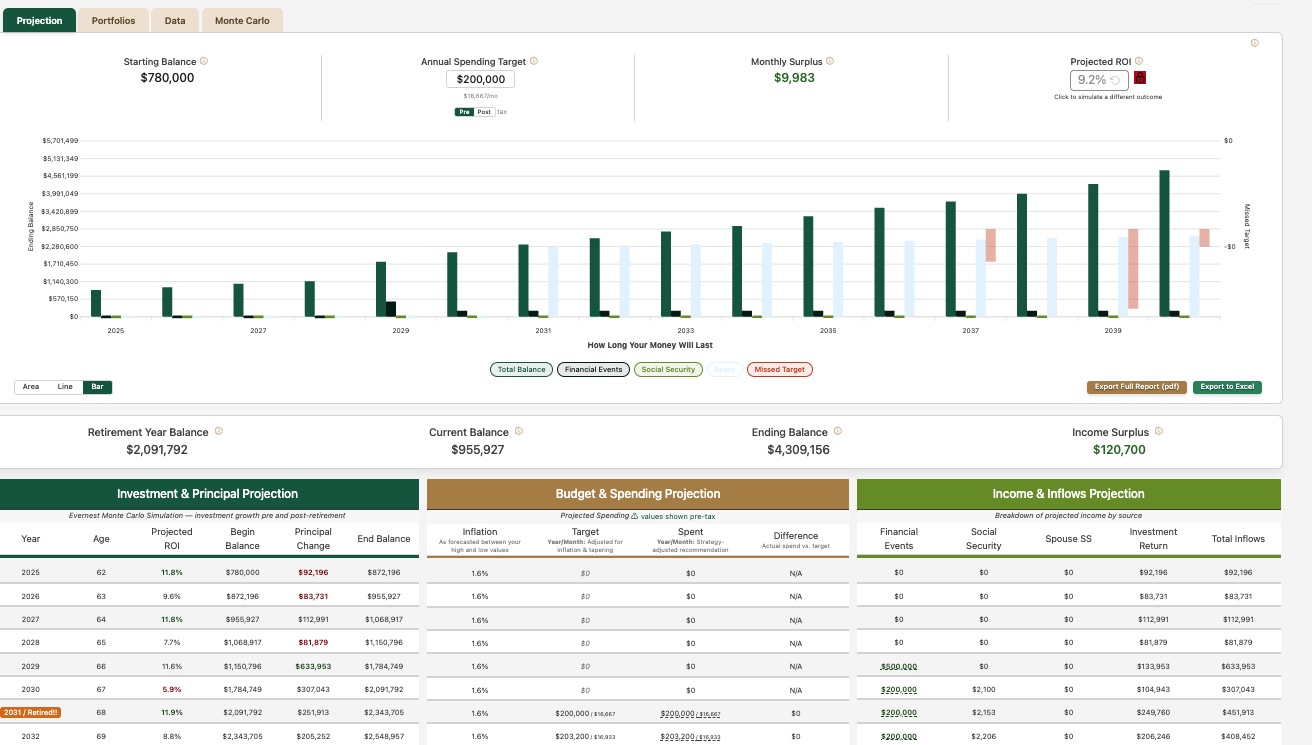
Your safe withdrawal rate is the spending level at which your portfolio survives through your planning horizon — typically age 90, 95, or 100. Evernest calculates this by projecting your finances year by year, accounting for investment growth, income from all sources, and your spending target.
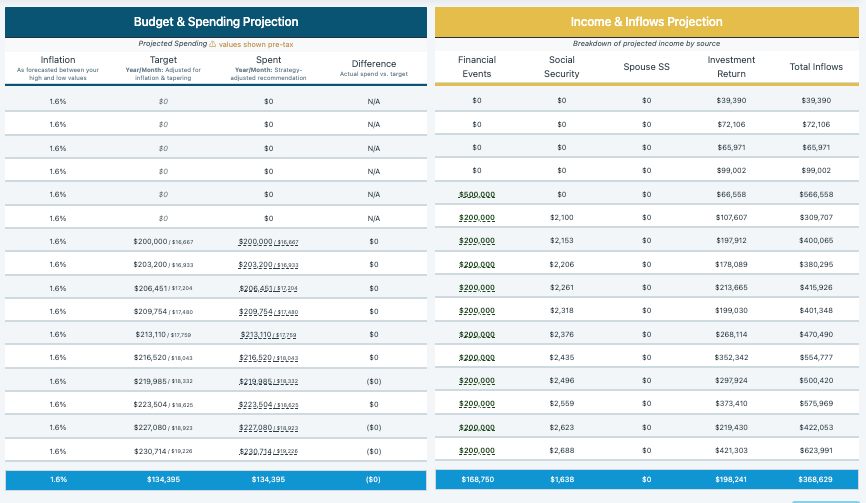
The process is simple: enter your portfolio balance, set a spending target, configure your income sources, and look at the projection. If your money runs out at 82, your withdrawal rate is too high. Reduce spending by $3,000 per year and check again. Keep adjusting until your portfolio survives through your target age. The spending level at that point, divided by your starting portfolio, is your personalized safe withdrawal rate.
What most people discover is that their safe rate is different from 4% — sometimes higher, sometimes lower, depending on their income sources and spending patterns. Someone with a $30,000 Social Security benefit and $600,000 in savings has a very different safe rate than someone with no Social Security and $1.2 million. The rule of thumb treats them the same. Your personalized rate doesn't.
Test Rates Against Your Real Numbers
The best way to understand your safe withdrawal rate is to test multiple rates and see the differences. Start at 3% — conservative and almost certainly safe. Then try 4%, 5%, and 6%. For each rate, note the year your portfolio hits zero (if it does). The gap between rates reveals how sensitive your plan is to spending changes.
You might find that at 4%, your money lasts to 96. At 5%, it lasts to 84. That one-percentage-point difference — about $5,000-$10,000 per year on a typical portfolio — costs twelve years of financial security. Seeing this tradeoff in concrete terms changes how you think about spending decisions.
Evernest makes this comparison instant. Change your spending target, and 30+ years of projections update in real time. Within ten minutes of testing, you'll have a clear sense of where your safe zone lies and how much flexibility you have.
Frequently Asked Questions
What is the 4% rule and does it still work?
The 4% rule suggests withdrawing 4% of your portfolio in year one of retirement, then adjusting for inflation each year. It was designed to survive the worst 30-year periods in market history. While it remains a useful starting point, it doesn't account for your specific income sources, spending patterns, or retirement length. Evernest lets you test any withdrawal rate against your actual financial picture.
How do I calculate my personal safe withdrawal rate?
Your personal safe withdrawal rate depends on your portfolio size, other income sources, spending needs, retirement length, and risk tolerance. Enter these into Evernest and test different spending levels — the software shows you year by year whether your money lasts. The rate at which your portfolio survives through your planning horizon is your safe rate.
Is 4% too high or too low for my situation?
It depends entirely on your circumstances. If you have significant Social Security income, 4% might be conservative. If you retire early or plan for a 40-year retirement, 4% might be too aggressive. The only way to know is to model your specific situation with your actual numbers.
Related Resources
Retirement Withdrawal Calculator
Test different withdrawal strategies and see how long your savings last.
Retirement Spending Planner
Find your sustainable spending level with taper strategies.
Retirement Savings Longevity
See exactly which year your money runs out — or if it never does.
How Long Will My Money Last?
Year-by-year projections showing your portfolio's lifespan.
Find Your Safe Withdrawal Rate
Go beyond the 4% rule. Test withdrawal rates against your actual portfolio, income, and spending — and find the rate that keeps your money lasting.
No credit card required · No signup needed for demo