Explore Different Retirement Scenarios
Most retirement planning tools ask you to input one set of assumptions and then give you one answer. But retirement isn't a single path — it's a web of decisions, each one affecting the others. When you retire matters. How much you spend matters. When you claim Social Security matters. And the interaction between these decisions matters most of all.
Retirement scenario planning lets you explore multiple versions of your future. Instead of committing to a single set of assumptions, you build two or three variations and compare the results. Retire at 62 with lower spending, or at 65 with more room to travel? Claim Social Security early and bridge with portfolio withdrawals, or delay to 70 and take a larger benefit for life? Each scenario produces a different 30-year projection, and the differences between them reveal which decisions actually move the needle.
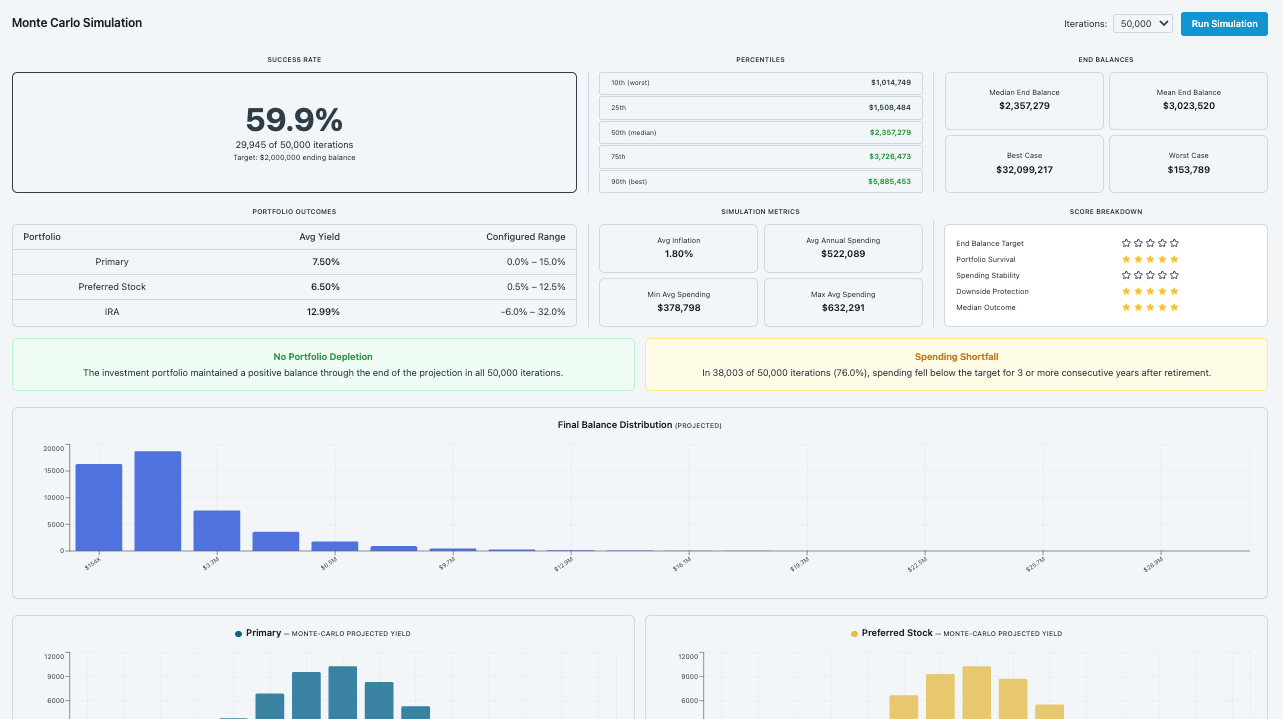
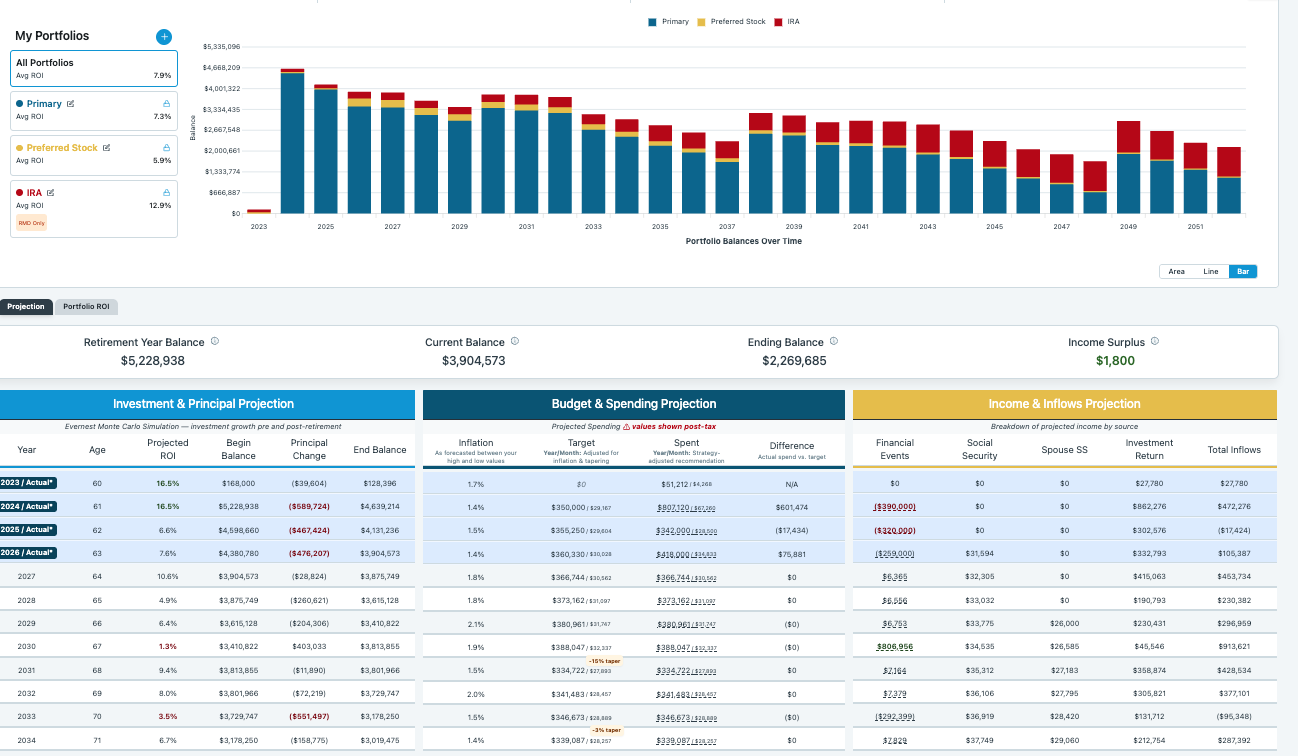
Evernest is built for this kind of exploration. Every input you change — retirement age, annual spending, Social Security timing, investment returns — recalculates your entire projection instantly. There's no waiting, no reconfiguring, no starting over. You adjust a single variable, and 30 years of projections update in front of you.
Compare Retirement Dates
Your retirement date is the single most impactful variable in your financial plan. Each additional year of work typically provides three benefits: one more year of savings contributions, one more year of investment growth, and one fewer year of withdrawals. The compounding effect of these three factors can be dramatic.
Consider someone with $500,000 saved at age 60 who contributes $20,000 per year and earns 6% annually. Retiring at 62 gives them roughly $610,000 to fund 28+ years of retirement. Retiring at 65 gives them roughly $790,000 to fund 25+ years. That's $180,000 more in savings and three fewer years to fund — a difference that can mean the gap between running out of money at 85 and having a comfortable cushion at 95.
But the right answer isn't always "work longer." If you hate your job, if your health is declining, if you have enough, the extra money might not be worth the extra years. Scenario planning helps you see the financial tradeoff clearly so you can weigh it against everything else that matters. Sometimes the answer is that two more years of work buys you ten more years of security. Sometimes it's that you're already fine and the extra work barely moves the needle. You won't know until you model it.
Test Spending and Income Changes
Retirement dates get the most attention, but spending and income changes can be just as powerful. A $5,000 annual reduction in spending might not sound significant, but over 25 years of retirement that's $125K in spending (not counting growth), before accounting for inflation. Combine that with the investment growth that money would have generated, and the real impact is even larger.
Evernest lets you test these adjustments with precision. You can model flat spending, tapered spending that decreases as you age (reflecting how most retirees actually spend), or custom spending schedules with planned increases and decreases. You can add part-time income in your early retirement years, model a spouse returning to work, or account for rental income from a property you plan to keep.
One-time events are equally important. Planning to sell your home and downsize at 72? That lump sum changes your withdrawal needs for every subsequent year. Expecting to help a child with a home down payment? That one-time expense might push your money's expiration date forward by two years — or it might barely register. You won't know until you add it to the model and see the impact ripple through your projection.
Make Better Retirement Decisions
The goal of scenario planning isn't to find the "perfect" plan — it's to understand the tradeoffs between realistic options so you can choose with confidence. When you can see that retiring three years early costs you $200,000 in long-term security, you can decide whether those three years of freedom are worth it. When you can see that delaying Social Security to 70 adds $150,000 to your lifetime income but requires bridging five years of higher withdrawals, you can evaluate that tradeoff on your own terms.
This is the difference between guessing and planning. Guessing feels uncertain because it is uncertain. Planning — real planning, with data — gives you a foundation for decisions even when the future is unpredictable. You may not know what the market will do, but you know that under conservative assumptions your money lasts to 92, and under slightly better assumptions it lasts indefinitely. That range is far more useful than a single number, and it's far more honest about what the future actually looks like.
Evernest puts this power in your hands. Every scenario you build is saved in your dashboard, ready to revisit and refine as your situation evolves. Retirement planning isn't a one-time event — it's an ongoing process, and the tool you use should support that. Test your assumptions today, revisit them next year, and keep refining until you're confident.
Create Your Free Account
Evernest is free to start with no credit card required. Build your first scenario in minutes by entering your current savings, expected retirement age, spending target, and Social Security estimates. The software calculates everything else — investment growth, withdrawals, income shortfalls, and your year-by-year balance through age 95 or beyond.
Once you've built your baseline, start experimenting. Change your retirement date by a year. Adjust your spending. Toggle Social Security timing. Each change produces a new projection instantly, and you'll quickly develop an intuition for which variables matter most in your situation. That intuition — backed by real numbers — is the foundation of a retirement plan you can actually trust.
Frequently Asked Questions
What is retirement scenario planning?
Retirement scenario planning is the process of modeling different versions of your retirement — varying your retirement date, spending level, Social Security timing, or income sources — and comparing the outcomes. Instead of betting on a single plan, you test multiple approaches and choose the one that gives you the best balance of lifestyle and financial security.
How many scenarios should I compare?
Start with two or three scenarios that represent meaningfully different paths — for example, retiring at 62 vs. 65 vs. 67. Once you understand how those compare, test variations within the strongest one. Most people find their answer within five to eight scenarios.
Can I model one-time events like selling a home or receiving an inheritance?
Yes. Evernest lets you add one-time income events and expenses to your timeline. A home sale at 70, a large medical expense at 80, or an inheritance at 68 — each event slots into your projection and its effects ripple through every subsequent year.
Related Resources
Retirement Planning Software
Comprehensive retirement modeling with year-by-year cash flow projections.
When Can I Retire?
Find your ideal retirement date by modeling ages 55 through 70.
Retirement Withdrawal Calculator
Test different withdrawal rates and see how long your savings will last.
Retirement Spending Planner
Balance lifestyle and financial security with smart spending strategies.
Explore Your Retirement Scenarios
Build your first scenario in minutes. Compare retirement dates, spending levels, and income strategies — and see how each decision affects your money for 30+ years.
No credit card required · No signup needed for demo