The Risk Nobody Talks About
You've saved diligently, invested wisely, and built a plan that shows your money lasting to 95. But that plan probably assumes average returns every year — something that never actually happens. Real markets are volatile. They crash. They recover. They go sideways for a decade. And the timing of that volatility relative to your retirement date can make or break your financial security.
This is sequence-of-returns risk, and it is the most underappreciated threat to retirement plans. Two retirees with identical savings, identical spending, and identical average returns over 30 years can have wildly different outcomes depending on when the bad years fall. If the crashes happen early — when you are drawing down your portfolio to fund spending — your money runs out years sooner than projected. If they happen later, you barely notice.
A retirement stress test reveals this risk by running your plan through thousands of different return sequences. Instead of one optimistic path, you see the full distribution of possibilities — and you find out exactly where your plan breaks.
How to Read Your Stress Test Results
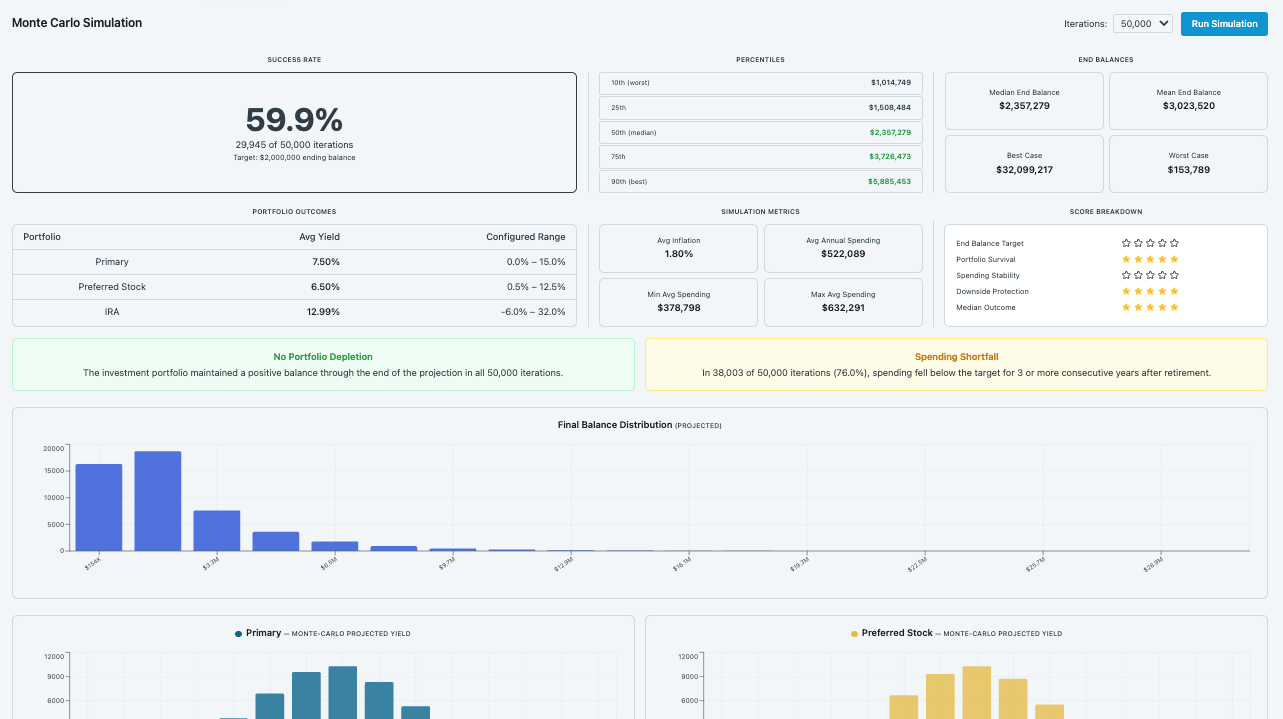
Evernest's stress test produces several key metrics. Your success rate tells you what percentage of scenarios met your financial goals. But dig deeper: the percentile breakdown shows you the range of outcomes. Your 10th percentile end balance is what happens in a bad-but-plausible scenario — one out of ten outcomes is this bad or worse. Your 90th percentile shows the upside when markets cooperate.
Pay close attention to the depletion rate — the percentage of scenarios where your money actually ran out. Even a plan with 85% success might have 8% of scenarios where your balance hit zero. The average year of depletion tells you when: running out at 92 is a very different risk profile than running out at 78.
The spending shortfall indicator adds another dimension. Even when your money technically lasts, some scenarios may require spending cuts in the final years. Evernest tracks how often your spending falls significantly below target for three or more consecutive years — a signal that your plan might survive but not comfortably.
Protecting Against Market Crashes
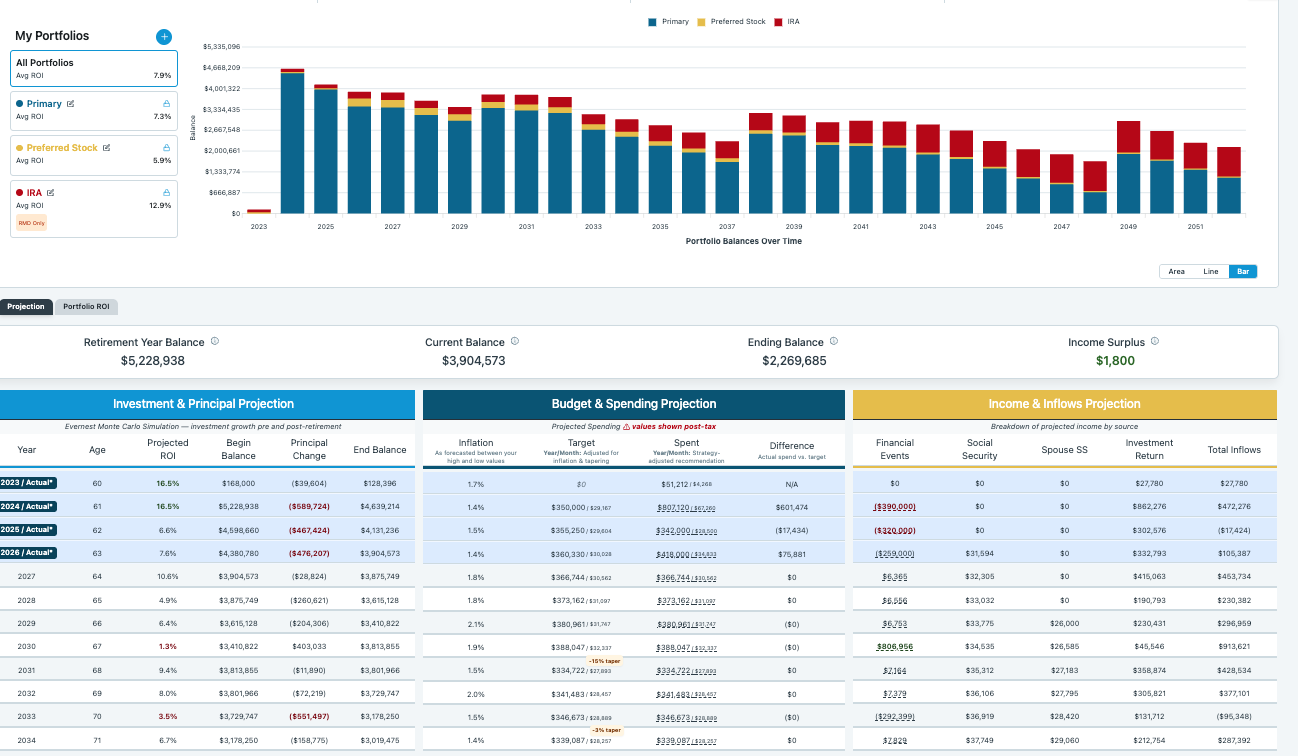
If your stress test reveals vulnerability, you have several strategies to improve resilience. The most direct is reducing spending — even a modest decrease in annual spending can dramatically improve your success rate because the effect compounds over 25 to 30 years. Evernest lets you model this instantly: adjust your spending target and run a new simulation to see the impact.
Portfolio allocation is another powerful lever. A dedicated bond or fixed-income portfolio set to draw first can shield your growth portfolio during early retirement — giving equities time to recover from a crash before you need to sell. Evernest's multi-portfolio engine lets you configure separate draw strategies for each portfolio, including a never-draw option that preserves capital until all other portfolios are depleted.
Flexible spending strategies also help. Instead of withdrawing a fixed dollar amount regardless of market conditions, strategies like spend-to-projected-need or flexible-budget automatically reduce spending during down markets and increase it during strong years. This adaptive approach can be the difference between a 72% success rate and a 91% success rate.
Inflation Stress Testing
Market crashes get the headlines, but sustained inflation can be equally damaging to a retirement plan. A dollar today buys less tomorrow, and over 30 years of retirement, even moderate inflation fundamentally changes your spending needs. Evernest randomizes inflation independently in each simulation iteration, testing your plan against scenarios ranging from your configured low (perhaps 1%) to your configured high (perhaps 4% or more).
The simulation averages panel shows you the mean inflation rate across all iterations, giving you context for the results. If your success rate drops significantly when you widen the inflation range, that's a signal that your plan is inflation-sensitive — and you may want to increase your inflation hedge through TIPS, I-bonds, or inflation-adjusted income sources.
Start Your Stress Test
Evernest is free to start with no credit card required. Build your retirement projection with your actual portfolio allocations, spending plan, and income sources. Then run a Monte Carlo stress test with up to 50,000 scenarios. Your results are saved as simulation history so you can track how plan changes improve your probability of success over time.
The difference between a plan that looks good and a plan that is good is stress testing. Your projection might show your money lasting to 97 under average assumptions. But if the stress test shows a 60% success rate, you know there's work to do. And with Evernest, every adjustment you make — spending, timing, allocation — can be re-tested in minutes.
Frequently Asked Questions
What is a retirement stress test?
A retirement stress test evaluates how your financial plan holds up under adverse conditions — market crashes, prolonged bear markets, high inflation, or an unlucky sequence of returns in your early retirement years. Instead of assuming everything goes according to plan, it asks: what if things go wrong, and will your money still last?
What is sequence-of-returns risk?
Sequence-of-returns risk is the danger that poor investment returns early in retirement will permanently damage your portfolio, even if returns average out over time. When you are withdrawing money, a 30% market drop in year one is far worse than the same drop in year twenty.
How does Evernest stress test a retirement plan?
Evernest uses Monte Carlo simulation to run your complete retirement projection thousands of times with randomized market returns and inflation. Each iteration uses your actual portfolios, draw strategies, financial events, and spending rules. The result is a probability of success based on how many scenarios leave you financially secure.
What should I do if my stress test results are poor?
If your success rate is below 70-80%, you have several levers: reduce your annual spending target, delay your retirement date by one to three years, adjust your portfolio allocation, configure a never-draw portfolio as a capital reserve, or add income sources like part-time work. Run a new simulation after each change to see how it improves your probability.
Related Resources
Monte Carlo Simulation
Deep dive into how Monte Carlo analysis works and how to interpret your results.
Scenario Planning Tool
Compare different retirement strategies side by side before stress testing.
Retirement Savings Longevity
Understand how long your savings will last under different assumptions.
Spending Planner
Balance lifestyle and financial security with smart spending strategies.
Will Your Money Last?
Find out before you retire. Run thousands of market scenarios against your plan and see exactly how resilient it is — and where to strengthen it.
No credit card required · No signup needed for demo