How Retirement Income Gets Taxed
Retirement income comes from several sources, and each is taxed differently. Traditional 401(k) and IRA withdrawals are taxed as ordinary income — every dollar you withdraw adds to your taxable income. Roth withdrawals are completely tax-free. Social Security is partially taxable depending on your total income. Pension income is generally fully taxable. Capital gains from taxable investment accounts may qualify for lower long-term rates.
The interactions between these sources create both risks and opportunities. A large traditional IRA withdrawal can push you into a higher bracket AND trigger taxation of your Social Security benefits — a double hit. Conversely, drawing from Roth accounts doesn't count as income for Social Security taxation purposes, potentially keeping your benefits tax-free.
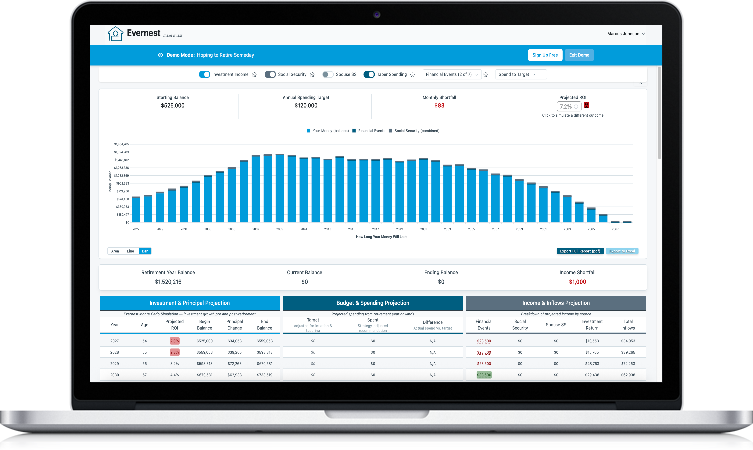
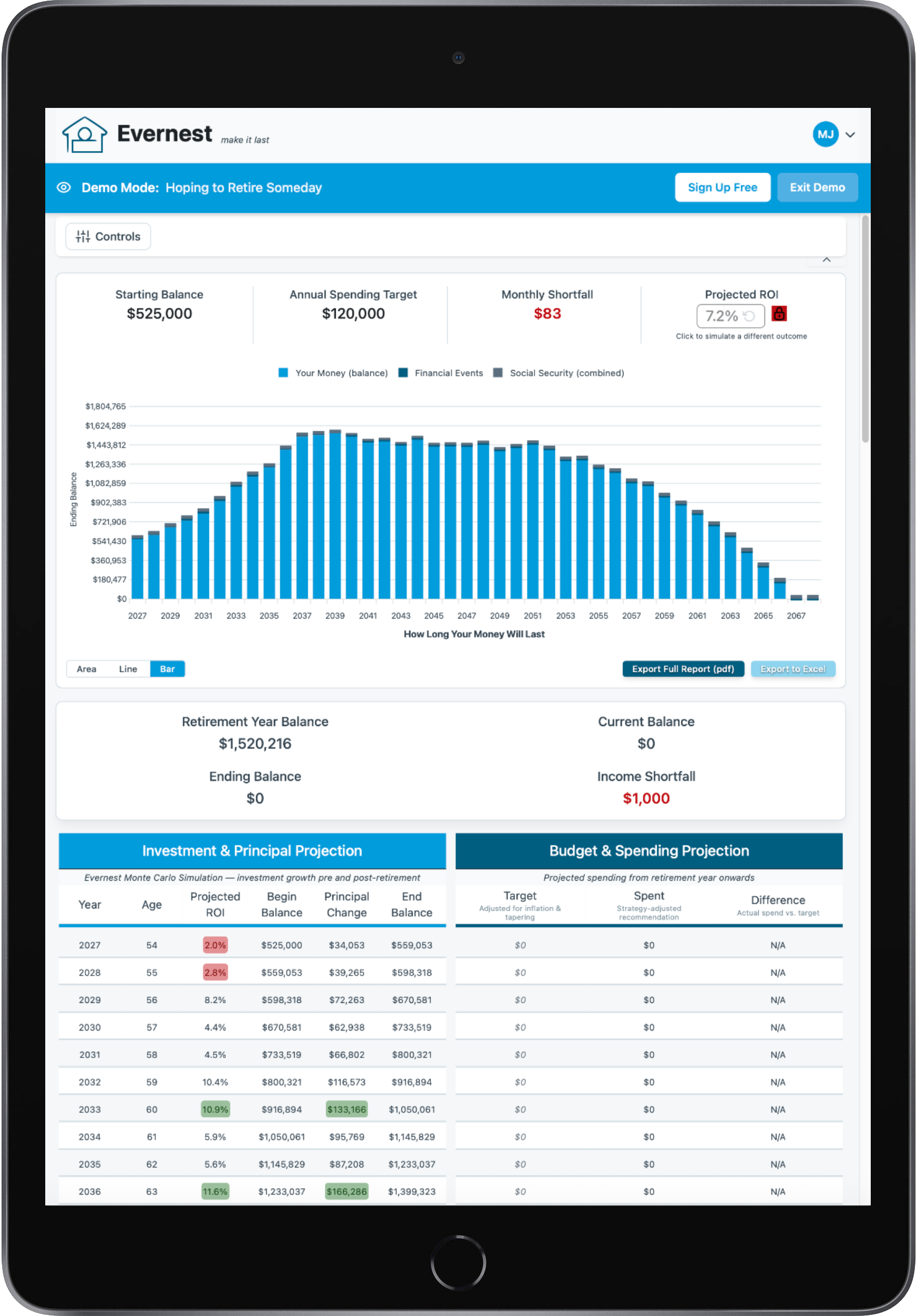
These interactions are nearly impossible to evaluate without projections. Evernest shows you how your total income from all sources stacks up year by year, making it visible when you're approaching thresholds that trigger additional taxation.
Strategies to Minimize Retirement Taxes
The most effective tax strategy in retirement is controlling your taxable income year by year. This means being intentional about which accounts you withdraw from, how much you withdraw, and in what order.
Bracket management: Know your tax bracket thresholds and plan withdrawals to stay within lower brackets. If you're in the 12% bracket with room before the 22% bracket, consider filling that space with Roth conversions or additional traditional withdrawals rather than letting that low-tax space go unused.
Roth withdrawal timing: Roth withdrawals don't count toward the income thresholds that trigger Social Security taxation. In years when your traditional withdrawals plus Social Security push you near taxation thresholds, substituting Roth withdrawals can keep your benefits tax-free.
RMD planning: Required minimum distributions from traditional accounts start at 73 and grow each year. If you have large traditional balances, RMDs can force you into higher brackets. Strategic Roth conversions before 73 can reduce future RMD amounts and give you more control over your taxable income.
Model Your Tax-Efficient Withdrawal Plan
Evernest's year-by-year projection shows your income from every source, making it possible to identify years when you have room for tax-efficient moves. The gap between your current income and the next bracket threshold is visible in your projection — and that gap represents an opportunity for Roth conversions or accelerated withdrawals at a lower rate.
By modeling different withdrawal sequences, you can compare the long-term effects. Does drawing heavily from traditional accounts early (paying more tax now but reducing future RMDs) beat a balanced approach? Does converting $25,000 per year for ten years outperform converting $50,000 per year for five? The answers depend on your specific tax situation, and projections let you test before committing.
Tax planning isn't about paying zero taxes — it's about paying the least total tax over your lifetime. Sometimes that means paying slightly more in the short term (through Roth conversions or accelerated withdrawals) to pay significantly less over 20-30 years. The projection shows you the full picture so you can make that tradeoff with confidence.
Frequently Asked Questions
Do I pay taxes on retirement income?
Yes, most retirement income is taxable. Traditional 401(k) and IRA withdrawals are taxed as ordinary income. Up to 85% of Social Security benefits may be taxable. Roth withdrawals are tax-free if the account has been open for at least five years. Understanding which sources are taxed and how they interact is essential for minimizing your retirement tax burden.
How can I reduce taxes in retirement?
Key strategies include drawing from Roth accounts for tax-free income, timing withdrawals to stay within lower brackets, considering Roth conversions during low-income years, managing income to reduce Social Security taxation, and coordinating withdrawal order. Evernest helps you model different strategies and see their effects.
At what income level does Social Security become taxable?
Social Security becomes partially taxable when combined income exceeds $25,000 (single) or $32,000 (married filing jointly). Up to 85% of benefits are taxable at $34,000 single / $44,000 married. Managing other income to stay below these thresholds can significantly reduce your total tax burden.
Related Resources
Roth Conversion Planning
Model your Roth conversion strategy and see the long-term impact.
Retirement Distribution Planning
Optimize the order and timing of account withdrawals.
Retirement Income Calculator
Estimate total retirement income from every source, year by year.
Retirement Income Planning Software
Build a complete income plan combining all your retirement sources.
Plan Your Tax-Efficient Retirement
See how withdrawal strategies affect your retirement income. Model different approaches and find the plan that minimizes your lifetime tax burden.
No credit card required · No signup needed for demo