Why Roth Conversions Matter for Retirement
Most retirement savings sit in pre-tax accounts — traditional 401(k)s and IRAs. Every dollar you withdraw is taxed as ordinary income. For retirees with large pre-tax balances, this creates a tax time bomb: required minimum distributions (RMDs) starting at age 73 force increasingly large taxable withdrawals that can push you into higher brackets, increase Medicare premiums, and trigger taxes on Social Security benefits.
A Roth conversion moves money from the pre-tax side to the tax-free side. You pay income tax on the converted amount today, but the money then grows tax-free and withdrawals are tax-free in retirement. Roth accounts also have no RMDs during the owner's lifetime, giving you complete control over when and how much you withdraw.
The strategy works best during low-income years — the gap between retirement and Social Security, or any year when your taxable income is unusually low. Converting just enough to fill your current tax bracket without spilling into the next one captures the maximum benefit. Over five or ten years of strategic conversions, you can significantly reduce your future tax burden while building a flexible, tax-free income source.
Model the Long-Term Impact
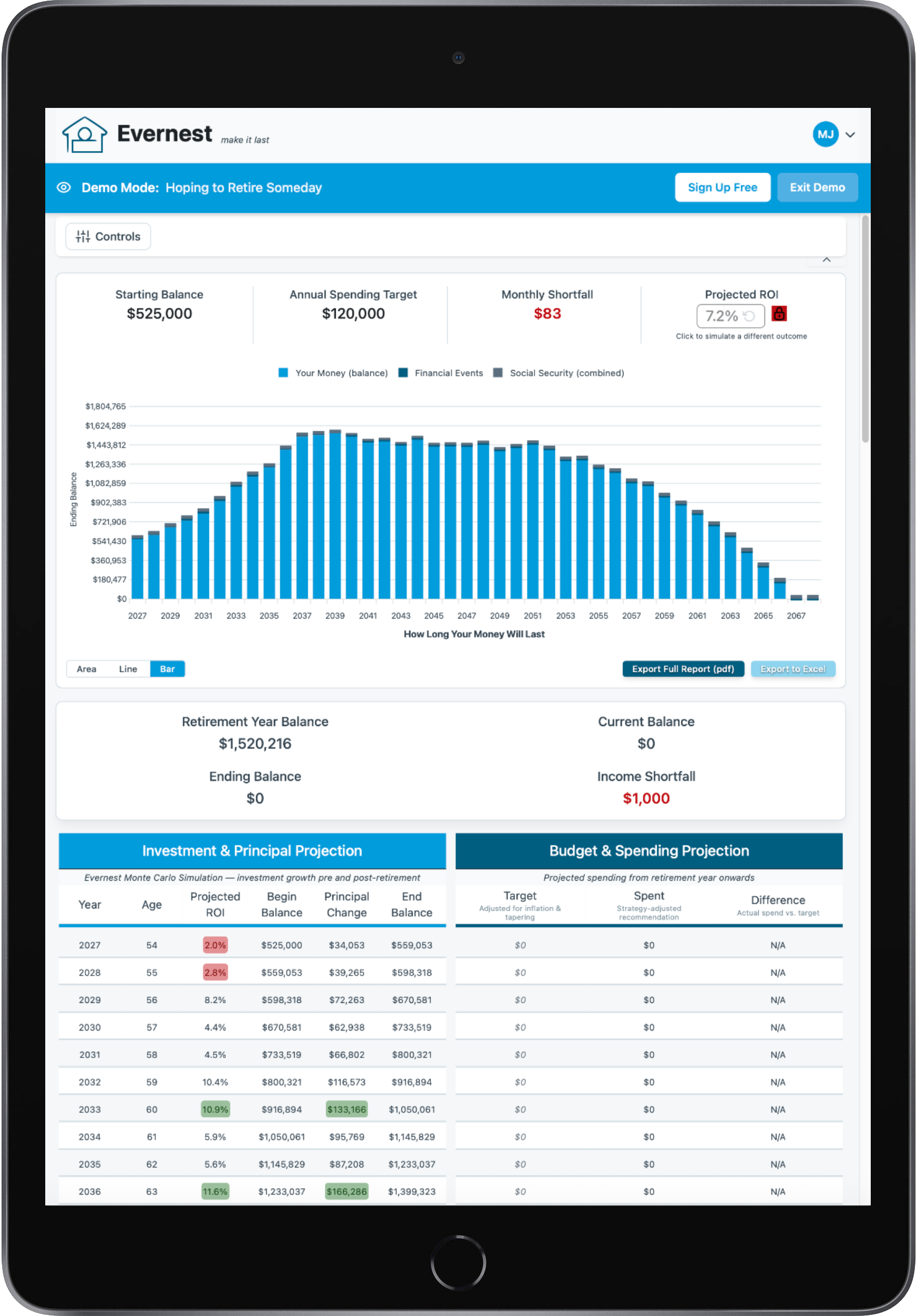
The challenge with Roth conversions is that the benefit plays out over decades. You pay a real tax cost today for a benefit that materializes 10, 20, or 30 years from now. That makes it hard to evaluate without projections — you need to see how the tax payment today affects your portfolio balance at 75, 80, and 85.
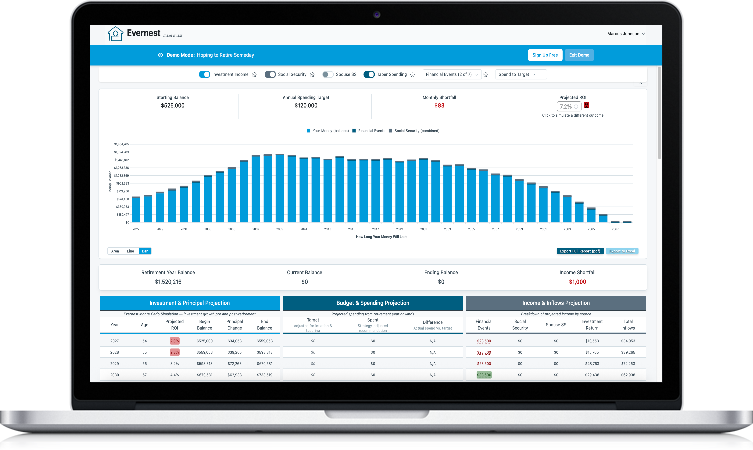
Evernest's year-by-year projection makes this visible. You can model your retirement with and without Roth conversions and compare the results. How does converting $30,000 per year for five years affect your portfolio at 80? How much does it reduce your future RMDs? How does the tax-free withdrawal flexibility change your income picture?
The answers vary dramatically by situation. Someone with $1 million in pre-tax accounts and modest Social Security might save hundreds of thousands in lifetime taxes through strategic conversions. Someone with a smaller balance and large Social Security might find the conversion taxes aren't worth the benefit. The projection shows you which category you fall into.
Build Your Conversion Strategy
A Roth conversion ladder — converting a set amount each year over several years — is the most common approach. The key decisions are how much to convert each year and how many years to continue. Convert too little and you miss the opportunity. Convert too much and you push yourself into a higher bracket, paying more tax than necessary.
The ideal conversion amount typically fills the gap between your current income and the top of your current tax bracket. If you're in the 12% bracket with $20,000 of room before hitting 22%, converting $20,000 per year captures the tax arbitrage without overpaying. Over five years, that's $100,000 moved to Roth at a 12% tax cost — far less than the 22% or 24% you might pay on RMDs from that same money later.
Evernest helps you evaluate these tradeoffs by showing the long-term portfolio effects. Model different conversion amounts, see how they affect your projected balance, and find the strategy that gives you the best combination of current tax efficiency and long-term financial flexibility.
Frequently Asked Questions
What is a Roth conversion?
A Roth conversion moves money from a traditional (pre-tax) retirement account to a Roth (after-tax) account. You pay income tax on the converted amount now, but the money grows and can be withdrawn tax-free in retirement. The strategy makes sense when you expect to be in a higher tax bracket later, or want to reduce future RMDs.
When is a Roth conversion a good idea?
Roth conversions are most valuable during years when your income is low — the gap between retirement and Social Security, years with large deductions, or years when you're in a lower tax bracket than you expect to be later. Convert enough to fill your current bracket without pushing into a higher one.
How does a Roth conversion affect my retirement projections?
A Roth conversion reduces your pre-tax portfolio balance (triggering a tax payment) but grows your tax-free Roth balance. Over time, the tax-free growth and withdrawals can improve your overall retirement income picture, especially when combined with reduced RMDs in your 70s and 80s.
Related Resources
Retirement Tax Planning
Strategies to minimize your tax burden throughout retirement.
Retirement Distribution Planning
Optimize the order and timing of your retirement account withdrawals.
Retirement Income Planning Software
Build a complete income plan combining all your retirement sources.
Retirement Planning Software
Comprehensive retirement modeling with full financial projections.
Model Your Roth Conversion Strategy
See how Roth conversions affect your retirement projections over 30+ years. Test different amounts and timing to find the strategy that works for you.
No credit card required · No signup needed for demo